The Event Manager, EVM, is a comprehensive event management system. In addition to providing traditional event handling facilities, EVM unifies its own events and events from other channels to provide a single source of information, simplifying the task of monitoring system activity. EVM includes a graphical event viewer and a full set of command-line tools. It is integrated into the SysMan Menu application suite and the SysMan Station.
The following topics are covered in this chapter:
Section 13.1 provides an overview of the Event Manager, EVM.
Section 13.2 describes how to set up and customize EVM.
Section 13.3 describes how to use EVM to assist in the administration of your system.
Section 13.4 describes how to troubleshoot common EVM problems.
Section 13.5 describes how to access the most recent version of Compaq Analyze.
A critical part of a UNIX system administrator's job is to monitor the state of the system, and to be ready to take action when certain unusual conditions occur, such as when a disk fills or a processor begins reporting hardware errors. It is also important to verify that certain routine tasks run successfully each day, and to review certain system configuration values. Such conditions or task completions are described as system events.
An event is an indication that something interesting has occurred - an action has been taken, some condition has been met, or it is time to confirm that an application is still operational. A particular event might be interesting to the administrator or to some other class of system user. If it is a system event it could also be significant to other system entities, such as:
System monitoring software
Operating system software
End-user application programs
Hardware components
Entities interested in events can either be part of the local system or of a remote system.
When a system component has something interesting to report, it makes the information available through an event channel. An event channel is any facility used to publish or retrieve event information. Examples of event channels are:
Log files, where messages are stored in a file that is usually in human-readable ASCII text format.
Event management systems
Programs that you run to obtain a snapshot of status information
An event management system is an active event channel and as such, it provides services for distributing, storing, and retrieving event information.
UNIX supports a number of channels through which system components can
report event and status information, and it is the administrator's responsibility
to check the information available at each channel regularly to be sure that
the system is operating normally.
The UNIX system logger,
syslog, and the binary error logger,
binlog, are familiar
examples of event management systems.
They provide simple event distribution
facilities for other components to use, and their daemons actively manage
the event information they receive.
By contrast, the
cron
daemon's log file,
/var/adm/cron/log, is an example of
a
passive
event channel.
The
cron
daemon writes new event information to the end of its file, and
takes no special action to notify interested entities when it does so.
Apart from
syslog
and
binlog,
there are several other logs stored in various locations, each of which might
require some level of monitoring.
The Event Manager, EVM, provides a single
point of focus for multiple event channels by combining events from all sources
into a single event stream.
The system administrator can either monitor the
combined stream in real time or view historical events retrieved from storage.
EVM's
viewing facilities include a graphical event viewer, which is integrated with
the SysMan Menu and SysMan Station, and a full set of command-line
utilities, which allow events to be filtered, sorted, and formatted in a variety
of ways.
EVM can also be configured to perform automatic notification of
selected conditions.
Rather than replacing the familiar event channels, such as
syslog
and
binlog, EVM encapsulates them.
These
channels remain in place, and continue to handle the same set of events as
they always did.
However, EVM makes the existing channels much more accessible.
EVM provides the following features:
Facilities for users and applications to post and monitor events
Support for all existing event channels, including
syslog
and
binlog
Support for encapsulation of custom event channels
Integration with DECevent and Compaq Analyze for translation of binary error log events
Integration of a graphical event viewer with the SysMan application suite
Choice of summary-line or detailed view of events, including online explanations
Full set of command-line utilities for posting and handling events from shell scripts and from the command line
Configurable event logger that allows full control over which events are logged and optimizes storage space used by identical events
Configurable event forwarding that allows automatic notification of selected events
Automatic log file management that performs daily archiving and purging tasks
Support for the application programming interface (API) library
Centralized event information
Configurable authorization for posting or accessing events
13.1.1 Understanding EVM Events
An EVM event is a binary package of data that can contain any or all of a set of standard data items, including a name, a timestamp, and information about the poster. An event might also contain variable data, which is named and supplied by the poster. For example, an event reporting the failure of a device might hold variables containing the path name and type of the device. Events are typically created and posted by an EVM posting client, and distributed to other clients by the EVM daemon. A receiving process can then extract and process the information contained in the event.
Although the EVM logger captures posted events and stores them in
a system log file, you can easily capture your own set of events and store
them in your own file for later analysis.
You use the
evmwatch
monitoring utility, or reconfigure the logger to capture your own events.
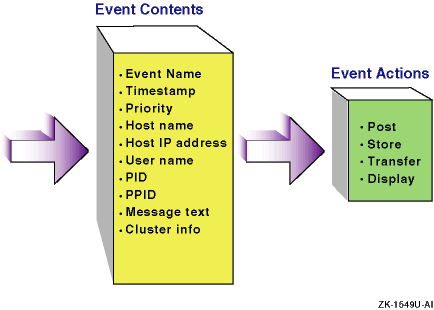
Figure 13-1
shows a graphical representation of an
event.
Figure 13-1: Event Model
In Figure 13-1, the Event Contents box shows some items that might be included in the event, such as the process identifier (PID) and the name of the host system on which the event was generated. The Event Actions box shows some of the possible actions performed on any event.
Because an event is a package of binary data, you cannot view it directly
with a text viewer such as the
more
command.
However, EVM
includes command-line utilities which understand the format of the event,
and which you use to perform basic operations at the UNIX command prompt or
in shell scripts.
You can use EVM commands to:
Retrieve events from storage, sort them into a preferred order, and format them for display
Watch for new events being posted
Post new events
The EVM utilities are designed to be used together in pipelines.
For
example, you might pipe a set of events from a file into the
evmsort
utility, and pipe the output into the formatting utility,
evmshow, then pipe the output of that command into
more, or redirect it to a file.
Section 13.3
provides
examples of using EVM commands to monitor and review event activity.
Once the event file has been converted to text form, you can use other
standard utilities to analyze it.
For example, you might display just the
event names, and then pipe the display into the
sort -u
and
wc -l
commands to determine how many different types
of events are in the file.
13.1.2 EVM Components
This section describes how the different parts of EVM interact.
It also describes the system files used to run EVM and any files created
by EVM during normal operations.
A model of the system is shown in
Figure 13-2.
Figure 13-2: EVM Component Model
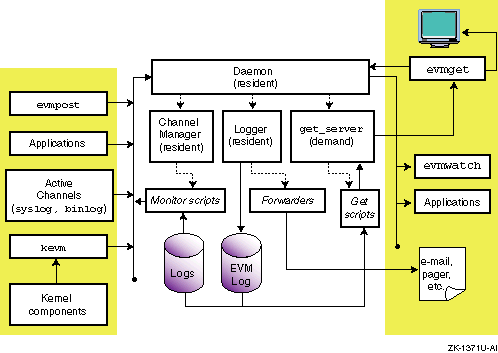
In Figure 13-2, client components involved in posting events are shown at the left, EVM system components in the center, and client components involved in subscribing and retrieval of events are at the right. Active event channels post events directly to EVM. Passive event channels do not post events and must be polled for information. These channels are depicted by the log files handled by the monitor scripts.
The primary
component of EVM is the
evmd
daemon, which is initialized
when the system is booted to run level two.
For event management to function
during system startup, the initialization of the daemon and its child processes
is synchronized as follows:
When you boot the system, some kernel components post events as part of their initialization sequences. Because the EVM daemon is not yet running, these events are queued in kernel memory until the daemon is ready to accept them.
The EVM daemon starts early in the run level two initialization sequence of system startup. (Refer to Chapter 3 for information on the system run levels.) The daemon then:
Once the logger establishes its listening connection and is ready to log events, the daemon begins accepting posted events from kernel and user-level posters.
The EVM
logger program,
evmlogger, runs as a resident process.
It is configured to subscribe to a selected set of events, and to store them
in managed log files for later retrieval.
The logger is also configured by
default to:
Write high-priority events to the system console
Send mail to the system administrator when high-priority events occur
The resident channel manager process,
evmchmgr, is
configured to run periodic channel-monitoring scripts, which post events when
they detect noteworthy activity in the channel.
The channel manager also runs
the daily log cleanup functions.
The
get server
process,
evmget_srv, is a transient (demand)
process that executes event retrieval scripts for the various event channels.
The
evmddaemon runs
evmget_srv
whenever
a user runs the
evmget
command.
Entities on the left side of the model create posting connections to the daemon in order to post events. As it receives events from the posters, the daemon merges them with corresponding event templates from its template database, and distributes them to its subscribing clients.
On the right side of the model,
evmwatch
and other application programs that need to receive event
information as it happens create
subscribing connections
to the daemon, and pass
filter strings
to it to specify
their event subscriptions.
The
evmget
command, which a user can run to retrieve
historical event information from log files, creates a
service
connection, and passes a filter string to specify the set of events
to be retrieved.
The daemon then runs an instance of the
get
server to handle the request.
The e-mail and pager actions are examples of
forwarding commands, which the logger might execute in response to the occurrence
of certain events.
13.1.2.1 EVM Command-Line Utilities
EVM provides a number of command-line utilities both for administering the EVM system itself and for use in posting or obtaining events. Table 13-1 describes the general user commands. Detailed information is available from the reference pages. Refer to Section 13.3 for examples of how to use these commands to monitor and review event activity.
Table 13-1: EVM Command-Line Utilities
| Command | Description |
Retrieves stored events from a configured set of log files and event channels, using channel-specific retrieval functions |
|
Accepts a file or stream of text event sources and posts them to the EVM daemon for distribution |
|
Accepts one or more EVM events and outputs them in the requested format |
|
Reads a stream of events and sorts them according to supplied criteria |
|
Subscribes to events specified and outputs them as they arrive |
Table 13-2
lists the EVM administrative commands
which are normally invoked during system initialization.
The individual command
reference pages discuss other conditions under which the command is used.
Table 13-2: EVM Administrative Utilities
| Command | Description |
The EVM daemon automatically starts the EVM channel manager. Do not start it manually. This command executes the periodic functions defined for any channel. |
|
The EVM daemon receives events from posting clients and distributes them to subscribing clients. (A subscribing client is one that has indicated that it wants to receive the events.) The daemon is a critical system facility that starts automatically at system boot. Do not terminate it. |
|
The EVM daemon automatically starts
the EVM logger.
The logger receives events from the daemon and writes them
to each of the logs whose filter string they match.
The
|
|
This command posts control events, which instruct EVM components to reload their configuration files. When you modify an EVM configuration file you must use this command to load the new configuration. |
|
This command starts the EVM daemon. It is intended for use by the system startup scripts, but you can also use it to restart EVM if it terminates for any reason. |
|
This command stops the EVM daemon, preventing events from being posted or subscribed to. It is intended for use by the system shutdown scripts. Because EVM is required for many system functions to operate correctly, you will not use this command under normal circumstances. |
13.1.2.2 EVM Application Programming Interface
The EVM
API library,
libevm.so, contains an extensive range of
event management functions.
This library enables programmers to design programs
that interface with EVM.
The API functions enable programs to post events,
send requests and notifications to the daemon, or receive responses and information
from the daemon.
Use of these interfaces is described in the
Programmer's Guide.
(See the
EVM(5)
reference for a list of individual API reference pages.)
13.1.2.3 EVM System Files
EVM creates or uses the following system files:
Executable files for EVM administrative commands are located
in
/usr/sbin.
Command executable files are located in
/usr/bin.
Initialization files are located in
/sbin/init.d.
Configuration files are located in
/etc
as follows:
The
/etc/evmdaemon.conf
file is a configuration
file read by the channel manager,
evmchmgr, and other EVM
facilities.
Refer to
Section 13.2.1.1
and the
evmdaemon.conf(4)
reference page for a complete description of this file.
The
/etc/evmchannel.conf
file is the configuration
file for the channel manager,
evmchmgr.
It describes all
the configured channels from which you can retrieve events.
Refer to
Section 13.2.1.2
and the
evmchannel.conf(4)
reference page for
a complete description of this file.
The
/etc/evmlogger.conf
file is the configuration
file for the logger,
evmlogger.
It contains commands used
to direct the display, forwarding, or storage of events.
Refer to
Section 13.2.1.3
and the
evmlogger.conf(4)
reference page for a complete description of
this file.
The
/etc/evm.auth
file is used to control
access to events and event services.
Refer to
Section 13.2.2.2
and the
evm.auth(4)
reference page for a complete description of this
file.
Log files, working files and local installation files are
located in the following subdirectories of
/var/evm:
The
/var/evm/sockets
CDSL directory contains
a domain socket node,
evmd, and a related lock file,
evmd.lck.
Local clients use this socket for connection.
The
/var/evm/evmlog
CDSL directory contains
the event logs created by the default EVM logger configuration.
Log files
in this directory have names in the format
evmlog.yyyymmdd[_nn],
where
yyyymmdd
is the date of the log, and
_nn
is a sequential generation number.
A new log generation starts
if the log reaches its configured maximum size during the course of the day,
or if the logger finds an error in the current file.
The day's first log
file has no generation number.
A new log file is started automatically when
it receives the first event after midnight, system time.
This directory also contains a lock file,
evmlog.dated.lck, and a generation control file,
evmlog.dated.gen,
the latter containing information about the current generation number.
See
Section 13.2.3
for more information on managing log files.
The
/var/evm/adm/logfiles
CDSL directory
contains output message logs created by the resident components of EVM:
the daemon, logger and channel manager.
New files are created each time EVM
starts.
Old files are renamed by appending a suffix,
.old,
to their names, overwriting any previous old files.
These message logs are
encapsulated by EVM's
misclog
event channel, so their
contents are visible through
evmget
and the event viewer.
The
/var/evm/shared
directory is a work
directory that holds temporary files required for client authentication.
The
/var/evm/adm/templates
directory is
provided for installation of local and third-party event template subdirectories.
This directory is connected to the system template directory by a symbolic
link.
The
/var/evm/adm/channels
directory is
provided for installation of local and third-party event channel scripts.
The
/var/evm/adm/filters
directory is provided
for installation of local and third-party event filter files.
The
/var/run/evmd.pid
file contains the
daemon process identifier (PID), that is saved by the
evmddaemon
for future actions, such as stopping EVM.
The
/var/run/evmlogger.info
file contains
the logger's process identifier and information about the log files being
managed.
The
evmlog
channel retrieval and daily cleanup
functions use this information.
System-supplied definition files for templates, channels,
and filters are located in the following subdirectories of
/usr/share/evm.
Do not modify these files:
The
/usr/share/evm/channels
directory contains
a subdirectory for system-supplied event channels such as
binlog,
syslog, and
evmlog.
Each
subdirectory contains scripts that define the services available for that
channel.
The
/usr/share/evm/filters
directory contains
system filter files.
The
/usr/share/evm/templates
directory
contains system event template files and subdirectories.
The following existing subsystems or optional components also provide event handling capabilities:
The system logger logs text messages on behalf of the kernel and many
user-level system components.
In addition to storing events in its own log
files, the default configuration of
syslogd
forwards selected
events to EVM for further storage and distribution.
EVM stores
syslog
events in the
evmlog
files to reduce the
overhead of retrieval from potentially very large text files.
Refer to the
syslogd(8)
reference page for more information.
Binary error logger (binlogd)
The binary error logger logs system errors and configuration information
in binary format.
Events are translated by the DECevent translation facility
(dia), or by Compaq Analyze (ca) depending
on the system type.
In addition to storing events in its own log files and
distributing them to its own clients, the
binlogd
daemon
forwards events to EVM for further distribution.
EVM retrieves binary
error log events from storage through the
binlog
event
channel functions.
Refer to the
binlogd(8)
reference page for more information.
DECevent and Compaq Analyze
DECevent is a rules-based translation
and reporting utility that provides event translation for binary error log
events.
EVM uses DECevent's translation facility,
dia,
to translate binary error log events into human-readable form.
Refer to the
dia(8)
reference page for more information.
Compaq Analyze performs a similar role
on some EV6 series processors.
Refer to the Compaq Analyze documentation and
ca(8)
reference page for more information.
The role of the administrator in running EVM involves the following principal activities:
Configuring EVM, described in Section 13.2.1
Controlling who is allowed to post or access events, described in Section 13.2.2
Managing log files, described in Section 13.2.3
Providing event reporting facilities for other system users, described in Section 13.2.4
Installing new products that use EVM capabilities, described in Section 13.2.5
For information on using EVM, see
Section 13.3.
13.2.1 Configuring EVM
Configuring EVM means establishing and maintaining its configurable resident components, which are:
The EVM daemon,
evmd
The channel manager,
evmchmgr
The logger,
evmlogger
Each component recognizes a configuration file that directs its operations.
When you install the operating system, EVM is automatically configured to run with default configuration options that are suitable for most installations. However, you can change the configuration for your system if, for example, an event channel is to be added or modified, the log file archive and expiration options need to be changed, or an alternate logging directory is established.
EVM is preconfigured to use both DECevent and Compaq Analyze to translate
binary logger (binlogd) events.
Whenever the configuration changes because a new file is loaded or because
a change is made, the configuration must be reestablished by running the
evmreload
command.
See the
evmreload(8)
reference page for
information on this command.
Configuration files are described in the following sections and in
the corresponding reference pages.
13.2.1.1 EVM Daemon Configuration
The EVM daemon reads the
/etc/evmdaemon.conf
configuration file at system startup and whenever you issue a reload request
using the
evmreload
command.
For a complete description
of the contents and syntax of the configuration file, see the
evmdaemon.conf(4)
reference page.
Example 13-1
shows some sample entries
in a daemon configuration file.
Example 13-1: Sample EVM Daemon Configuration File Entries
# Event template directory: sourcedir "/usr/share/evm/templates"[1] # Start the EVM Logger [2] start_sync "/usr/sbin/evmlogger -o /var/run/evmlogger.info\-l /var/evm/adm/logfiles/evmlogger.log" # Start the EVM Channel Manager [2] start_sync "/usr/sbin/evmchmgr -l\/var/evm/adm/logfiles/evmchmgr.log" # Event retrieval service definition: service [3] { name event_get command "/usr/sbin/evmget_srv" } # Set up an activity monitor. activity_monitor [4] { name event_count period 10 threshold 500 holdoff 240 } remote_connection false [5]
This statement identifies the top of the directory hierarchy for all event template files. [Return to example]
These commands start the
evmlogger
and the
evmchmgr
components as synchronized
clients, ensuring that both clients complete their subscription requests before
the daemon accepts any events from posting clients.
The command-line options
for these commands define the clients' log files and, in the case of the logger,
an output file that is used to make operational details available to the
evmlog
event channel functions.
[Return to example]
These statements define the
event_get
event retrieval service, which the
evmget
command
uses to retrieve events.
[Return to example]
These statements define an activity monitor. If 500 or more events are received during any ten minute period, the daemon posts a high-priority event to alert the system administrator. Activity monitoring (counting) of events is then suspended for the hold-off period of four hours (240 minutes). [Return to example]
This line sets the
remote_connection
to
false
to disable connection to this system
by remote EVM clients.
Refer to the
evmdaemon.conf(4)
reference page and
to
Section 13.2.2
for information about the security implications
of changing this value.
[Return to example]
If you make any changes to the configuration file you must run
evmreload(8)
to make the changes known to the EVM daemon.
13.2.1.2 EVM Channel Configuration
An event channel is a source of event
information.
The channel configuration file,
/etc/evmchannel.conf, defines a set of event channels and the functions that operate
on them, for use by the channel manager, by the
evmshow
command, and by the event retrieval process.
For a complete description of
the contents and syntax of the channel configuration file, see the
evmchannel.conf(4)
reference page.
Example 13-2
shows sample channel configuration
entries.
Example 13-2: Sample EVM Channel Configuration File
# Global path for channel functions
path   /usr/share/evm/channels [1]

# Time-of-day at which daily cleanup function will run
cleanup_time 02:00:00                              [2]

# ==================================
# Event channel:  EVM log
# ==================================
channel
  {[3]
    name        evmlog[4]
    path        /usr/share/evm/channels/evmlog
    events      *[5]
    fn_get      "evmlog_get"
    fn_details  "evmlog_details"
    fn_explain  "evmlog_explain"
    fn_monitor  "evmlog_mon"
    fn_cleanup  "evmlog_cleanup 7 31"[6]
    mon_period  15:00  # Monitor every 15 minutes[7]
   }
This line declares the
/usr/share/evm/channels
directory as the default path for all channel functions.
This
path is prefixed to the names of any channel functions defined in this file
that do not begin with a slash (/) character, unless the
channel group supplies its own path value.
[Return to example]
This line defines a daily 2:00a.m. cleanup for all channels. [Return to example]
This line specifies a configuration group that defines an event channel. [Return to example]
This line specifies that the name of the
channel is
evmlog.
[Return to example]
In this line, the asterisk (*)
indicates that the channel provides default event handling, meaning that its
functions are invoked to provide details and explanations for any events whose
names do not match the events value of any other channel.
[Return to example]
This line defines the arguments to this function that specify when the cleanup occurs. In this example, log files older than seven days are compressed and log files older than thirty-one days are deleted. [Return to example]
This line sets the monitoring period, causing
the
/usr/share/evm/channels/evmlog/evmlog_mon
function
to be invoked every 15 minutes.
[Return to example]
The EVM logger handles storage and forwarding of
events, according to entries in the
/etc/evmlogger.conf
configuration file.
For a complete description of the contents and syntax
of this file, see the
evmlogger.conf(4)
reference page.
Example 13-3
shows sample entries in a logger configuration file.
An example of possible
customization of the logger is to direct output to a terminal in addition
to a log file.
Example 13-3: Sample EVM Logger Configuration File Entries
# Main log file:
eventlog {                                 [1]
 name        evmlog                        [2]
 logfile     /var/evm/evmlog/evmlog.dated  [3]
 type        binary                        [4]
 maxsize     512  # Kbytes                 [5]
# Uncomment the following "alternate" line and set the
# logfile path to specify an alternate logfile in case
# of write failures. The path must specify an existing
# directory.
# alternate  /your_alternate_fs/evmlog/evmlog.dated [6]
  # Log all events with priority >= 200, except binlog events:
  filter  "[prio >= 200] & (! [name @SYS_VP@.binlog])" [7]

  # Suppress logging of duplicate events:
  suppress [8]
  {   filter      "[name *]"
      period      30    # minutes
      threshold   3     # No. of duplicates before suppression
   }
}
  # Forward details of high-priority events to root:
    forward { [9]
    name      priority_alert [10]

  # Don't forward mail events through mail
    filter  "[prio >= 600] & ![name @SYS_VP@.syslog.mail]" [11]

    suppress  [12]
{  filter  "[name *]"
   period  120    # minutes
   threshold   1  # No. of duplicates before suppression
 }
# This evmshow command writes a subject line as the
# first line of output, followed by a detailed display
# of the contents of the event. The resulting message is
# distributed by mail(1).
command "evmshow -d -t 'Subject: EVM ALERT [@priority]: @@' | \
mail root" [13]
    }
This line specifies the configuration group that defines an event log. [Return to example]
This line specifies that the
evmlog
event channel uses the
name
to obtain configuration
information about the log.
[Return to example]
This line specifies that the log files are
stored in the
/var/evm/evmlog
directory.
Each day, when
the log for that day is first written, the
dated
suffix
is replaced by the date in the format
yyyymmdd.
[Return to example]
This line specifies that the
type
of events written to this log are binary EVM events, rather than
formatted (ASCII text) events.
[Return to example]
This line specifies the maximum size of the log file in kilobytes (KB). In this case, if the size of the current log file exceeds 512 KB the logger closes it and begins a new log file, with a sequentially numbered suffix (for example, _2) appended to the file name. [Return to example]
If this line is uncommented and the sample path is replaced by the path name of an existing write-enabled directory, an alternate log file is opened in this directory if the primary directory becomes write-disabled. [Return to example]
This line establishes the filtering conditions
for events, determining which events are logged by this event log.
Refer to
the
EvmFilter(5)
reference page for details of EVM filter syntax.
[Return to example]
These statements define the suppression
parameters for this event log.
In this case, suppression of a particular event
begins if three or more duplicate events are received within 30 minutes.
Suppression
of duplicate events saves space in the log file.
Refer to the
evmlogger.conf(4)
reference page for a detailed description of event suppression.
[Return to example]
This line establishes conditions for forwarding events to the root user. An event forwarder executes a specified command string when selected events occur. It is useful for notifying the system administrator when a significant error occurs. [Return to example]
In this line,
name
identifies
the forwarder.
[Return to example]
This line establishes filtering for the events. As with an event log definition, the filter string specifies the set of events that are handled by this forwarder. To prevent an event loop from occurring if the mailer posts high-priority events, signifying a possible problem in the mail subsystem, mail events are explicitly excluded from this forwarder. [Return to example]
These lines suppress multiple forwarding of events. The suppression mechanism for a forwarder is similar to that for an event log. Here, the purpose is to prevent the command from being sent multiple times in a short period due to the same event being posted repeatedly. In the example, a particular event is forwarded once every two hours. [Return to example]
This line defines the command that execute
when an event is handled by the forwarder.
The event is piped into the command's
stdin
stream.
The result of this command is shown in the comments
preceding the command line.
[Return to example]
If you make any changes to the logger configuration file you must run
the
evmreload
command to make the changes known to the
logger.
13.2.2 Security Considerations
Security is an important consideration when dealing with events, for the following reasons:
Uncontrolled access to certain event information might provide an unauthorized user with sensitive information about system operation.
Posting certain events might cause critical system actions to occur. For example, application failover or system shut down.
Traditionally, event information security is maintained by restricting
read access to log files and limiting certain posting operations to the
root
user.
Because the EVM daemon and event retrieval facilities
provide alternate means of access to all events, both as they are posted and
after they are logged, the daemons also provide a way to limit access, so
that events are seen only by authorized users.
You can enable access control
by providing authorization facilities and using authentication techniques.
You must also be careful to avoid compromising security when writing executable
functions to be used in the EVM environment.
Refer to the
Programmer's Guide
for more information about protecting channel functions.
13.2.2.1 User Authentication
The EVM daemon authenticates the identities of all local system
users before accepting any connection request.
There is currently no authentication
of remote users.
See
Section 13.2.2.3
for information about
remote connections.
13.2.2.2 User Authorization
Access to events is controlled by the EVM authorization file,
/etc/evm.auth.
The root user can authorize individual users or groups of users to do the following:
Post selected events
Access (subscribe to or retrieve from storage) selected events
Execute selected services
By default,
all events are protected.
Event rights are granted by supplying, for each
event class, a list of users who have the specified right or who are explicitly
denied rights.
An indicator (+ or -) that is not followed by a user list implicitly
grants or denies the right to all users.
The root user has implicit posting
and access rights to all events unless explicitly denied them.
Example 13-4
shows sample entries in an authorization file.
See the
evm.auth(4)
reference
page for additional details.
Example 13-4: Sample EVM Authorization File Entries
# ===================
#      EVENTS
# ===================

event_rights {                             [1]
   class        @SYS_VP@.evm.control   # EVM control events
   post         root
   access       +
}

event_rights {                             [2]
   class        @SYS_VP@.evm.msg.admin  # EVM admin message
   post         root
   access       "root, group=adm"
}

event_rights {                             [3]
   class        @SYS_VP@.evm.msg.user         # EVM user message
   post         +
   access       +
}


# ===================
#      SERVICES
# ===================

service_rights {                           [4]
   service      event_get
   execute      +
}
Only root can post the class of events that
have names beginning with
sys.unix.evm.control.
Such
events are accessible by all users.
The
@SYS_VP@
entry is a macro that is replaced with
sys.unix
when the
file is read.
[Return to example]
Only root can post the class of events that
have names beginning with
sys.unix.evm.msg.admin.
Such
events can be accessed by root or anybody in the
admin
group.
[Return to example]
All users can post or access the class of
events that have names beginning with
sys.unix.evm.msg.user.
[Return to example]
All users can execute the
event_get
service.
[Return to example]
If you make any changes to the authorization file you must run the
evmreload
command to make the changes known to the EVM daemon.
13.2.2.3 Remote Access
EVM is accessible to clients that are running on remote systems, allowing
you to monitor and retrieve events from a central system.
You can make a
remote connection by specifying a host name or IP address using the
-h
option with the
evmwatch,
evmget
and
evmpost
command-line utilities.
Alternatively, specify
a remote host name in the event viewer's Get Events From...
dialog box.
Because EVM currently has no means of authenticating remote clients, it imposes the following restrictions to avoid compromising security:
By default, remote access is disabled in the daemon's configuration
file,
/etc/evmdaemon.conf.
If you wish to enable remote
access, edit this file and set the value of the
remote_connection
keyword to
true, then run the
evmreload
command specifying the
-d
option.
Only enable remote access if your system is running in a fully secure environment.
The EVM daemon grants remote clients only the lowest level of access or posting privileges. This means that remote clients can access or post only events that any local client can post or access.
The EVM channel manager,
evmchmgr, provides
log management capability through the channel
fn_cleanup
function, which you can define for any channel through the channel configuration
file,
evmchannel.conf.
See
Section 13.2.1.2
for additional information on this file.
By default, channel cleanup functions run when EVM starts, and then
at 2:00a.m.
every day.
You can change the time of day by editing the
cleanup_time
value in the channel configuration file.
When a cleanup
is scheduled, the channel manager scans the event channel list, and executes
the
fn_cleanup
command for each channel identified in the
file.
The
evmlog
cleanup function,
evmlog_cleanup, takes two arguments as follows:
The archive period, which has a default value of 7 days.
The delete period, which has a default value of 31 days.
The function uses the
find
utility to locate
and compress (zip) all logs older than the archive period, and to delete any
archived files older than the delete period.
You can change the period values
by editing the function definition in the channel configuration file.
See
Section 13.2.1.2
for a description of this file.
Setting either
of these values to zero disables the corresponding function.
Logs are compressed
for archive using the
gzip
command.
See the
gzip(1)
reference page.
The
default channel configuration also provides a similar cleanup function for
the SysMan Station message log files, through the
misclog
event channel.
You can manage the
syslog
and
binary
error log channels using
crontab
entries.
Because the binary error log file is typically not managed on a daily basis,
the channel's cleanup function posts a daily EVM event reporting the size
of the log.
If the log is growing significantly, review the log entries
and, if necessary, use the cleanup options in
binlogd
to
initiate a cleanup.
See the
binlogd(8)
reference page for more information.
Note that
evmget
does not retrieve
evmlog
events stored in archived (zipped) logs.
To retrieve events
from archived logs you must first uncompress them with the
gunzip
command.
See the
gunzip(1)
reference page for information on
unzipping archive files.
13.2.4 Event Templates
An event template is a centrally held description of an event. The template is used for the following purposes:
To register the event with the EVM daemon, so that it will allow the event to be posted
To hold centralized information, avoiding the need to have it hard-coded into an application
Event template definitions are held in template files, which are text
files stored in directories subordinate to (or linked to) the system template
directory,
/usr/share/evm/templates.
If you have installation-specific
or third-party event templates, load them as follows:
Create an appropriately-named subdirectory of the local template
directory,
/var/evm/adm/templates, and copy the event templates
into it.
Run the
evmreload
command, specifying the
-d
option, to signal the EVM daemon to reload its internal template
database.
Each time an event is posted, the EVM daemon looks in its internal template database for a template event whose name matches the posted event. It then retrieves any centralized data items held in the template event, and combines them with the items the program supplied when it posted the event, to yield a merged event for distribution to subscribers.
Template
files require specific ownership and permissions to be recognized by EVM.
See the
evmtemplate(4)
reference page for details.
Refer to the
Programmer's Guide
for more information on installing new event template files.
13.2.5 Installing New EVM Clients
You can add new events to the event set as new applications are installed and as new administrative scripts are developed to use the facilities. As events are added it might be necessary to modify EVM configuration and authorization files, and to add new templates. See Section 13.2.1 for a discussion of the various configuration files. See Section 13.2.2.2 for information on changing the authorization for new users.
Add new event templates as follows:
Create new template files as described in Section 13.2.4.
Copy the template files to the
/var/evm/adm/templates
directory or to a subdirectory.
Run the
evmreload
command, specifying the
-d
option, to signal the EVM daemon to reload its internal template
database.
Refer to the
evmtemplate(4)
reference page for details of the
required ownership and permissions of a template file.
Refer to the
Programmer's Guide
for additional information about developing EVM
client applications.
13.2.6 Configuring binlog Event Translation Utilities
DECevent is a rules-based translation and reporting utility that provides
event translation for binary error log events.
EVM uses DECevent's translation
facility,
dia, to translate binary error log events into
human-readable form.
Some newer processors do not support DECevent and can
only support Compaq Analyze.
Compaq Analyze is a rules-based hardware fault management diagnostic tool that provides error event analysis and translation. The multi-event correlation analysis feature of Compaq Analyze provides the capability to analyze events stored in the system's event log file and to analyze events from other systems, including other operating systems such as OpenVMS and Windows NT.
Although the EVM infrastructure directly recognizes events only in
its own EVM format, events are posted through other channels, such as
binlogd.
These events can be passed to EVM within a wrapper EVM
event by inserting the lower-level event into the EVM event as variable
data.
The whole package is then passed to EVM without EVM having any
knowledge of the content or format of the variable.
The binary logger daemon,
binlogd, uses this approach
to make its own events available through EVM.
When
binlogd
receives an event from the operating system it first stores the event in its
own log file and distributes it to its own clients, in its traditional manner.
It then creates an EVM event named
sys.unix.binlog,
and adds a variable called
binlog_event, containing the
binlogd
event data.
Finally, it posts the package to the EVM
daemon for further distribution.
The EVM daemon deals with the package
as it would any EVM event, and has no direct knowledge of the contents of
the
binlog_event
variable.
When you request a detailed view of an event, either by running the
evmshow -d
command from the command line or by selecting the Details...
button in the event viewer's event summary window, EVM runs the detailed
display program defined for the event in the
/etc/evmchannel.conf
file.
The resulting display always begins with an explanation
of the event and a detailed view of its contents.
If the event is a
binlogd
event, this display is followed by a translation of the
contents of the
binlog_event
variable.
This translation
is useful if you are troubleshooting a system problem.
Example 13-5
shows a detailed display of a
binlogd
event, including
a DECevent translation:
Example 13-5: A binlogd Event Showing the DECevent Translation
=================== Binary Error Log event ====================
EVM event name: sys.unix.binlog.op.shutdown
 Binary error log events are posted through the binlogd
 daemon, and stored in the binary error log file,
 /var/adm/binary.errlog. This event is posted by the shutdown(8),
 halt(8), and reboot(8) commands when the system is being shut
 down. The message includes details of the user who initiated
 the shutdown.
===============================================================
Formatted Message:
    System shutdown msg:  System rebooted by root:
Event Data Items:
    Event Name        : sys.unix.binlog.op.shutdown
    Priority          : 200
    Timestamp         : 26-Jan-2000 20:54:36
    Host IP address   : 16.69.224.11
    Host Name         : kopper
    Format            : System shutdown msg: $message
    Reference         : cat:evmexp.cat:300
Variable Items:
    subid_class = 301
    message = "System rebooted by root:"
    binlog_event = [OPAQUE VALUE: 96 bytes]
============================ Translation =====================
DECevent version: V3.2

Logging OS                       2. operating system
System Architecture              2. Alpha
Event sequence number          752.
Timestamp of occurrence             26-JAN-2000 20:54:36
Host name                           kopper
System type register      x0000000F  AlphaStation 600 or 500
Number of CPUs (mpnum)    x00000001
CPU logging event (mperr) x00000000
Event validity                   1. O/S claims event is valid
Event severity                   5. Low Priority
Entry type                     301. Shutdown ASCII Message Type
SWI Minor class                  9. ASCII Message
SWI Minor sub class              2. Shutdown
ASCII Message                    System rebooted by root:
===============================================================
EVM obtains the
binlogd
event translation by passing
the event to either DECevent or Compaq Analyze.
If neither of these programs
is available, or if the translation attempt fails for any reason, the translation
area of the display shows a message indicating the failure.
Several factors govern the type of
binlogd
event
translation that is available on any given system:
DECevent is available for older-generation Alpha processor platforms, including some early EV6 platforms. Compaq Analyze must be used to translate events for newer EV6 platforms.
If DECevent is to be used for translation, the DECevent event
formatter utility,
/usr/sbin/dia, must be installed on
the local system.
If the utility is not installed on your system, you will
need to install it from the Associated Products CD-ROM.
Consult your installation
documentation for more information.
If your system is supported by Compaq
Analyze you do not need to install DECevent.
Unlike DECevent, Compaq Analyze uses a client/server model and it is not necessary to install it on every system that will use it. If your site has licensed Compaq Analyze to run on only a small number of systems, those systems can still provide translation services for other systems. If you need to use a remote Compaq Analyze server to do translations, you must edit the local channel configuration file, as described below.
Recent processors produce
binlogd
events
with a new header format that differs from the format produced by earlier
platforms.
The newer format events are known as Common Event Header (CEH)
events.
If your system does not produce CEH events you cannot use Compaq
Analyze to translate them, and you must install the DECevent formatter utility,
/usr/sbin/dia.
If your system will use DECevent for
binlogd
event
translation, or will use a Compaq Analyze server running on the local system,
you do not need to change the standard configuration.
If you plan to use
a Compaq Analyze server running on a remote system, you will need to edit
the
/etc/evmchannel.conf
file.
In a default installation,
the
fn_details
line for the
binlog
event
channel is configured as follows:
fn_details "binlog_details -decevent -ca localhost"
This line instructs EVM to use DECevent to provide translations
if it is available; otherwise EVM attempts to connect to a Compaq Analyze
server running on the local host.
If neither of these options is successful,
no translation is done.
It is advisable to leave these options in place as
the first two items in the list, but if you have other systems running the
Compaq Analyze server you can opt to append further
-ca
items.
In the following example, EVM will try in turn DECevent, Compaq
Analyze on the local system, Compaq Analyze on the remote system
gandalf, and finally Compaq Analyze on the remote system
tigger.
(This line has been broken at the backslash (\) to fit the
page, and appears as a single line in the file).
fn_details  "binlog_details -decevent -ca localhost -ca gandalf \
-ca tigger"
After you edit the file, run the
evmreload -c
command
to make the EVM channel manager aware that the file has been updated.
Note that EVM does not start the Compaq Analyze server; it must already
be running on the selected system for the translation to succeed.
The server
usually starts automatically when the system is initialized.
For more information,
log onto a system that has Compaq Analyze installed and refer to the
desta(8)
reference page.
See
Section 13.4
for procedures that enable
you to test whether either translation utility is available on your system.
13.3 Using EVM in System Administration
The ability of EVM to monitor
multiple event sources and combine them into a single event stream makes it
a very useful means of monitoring system activity.
By default, the logger
is configured to send mail to the root user when events with a priority of
600 (alert) or greater are posted, but take care to check the full event log
on a daily basis, using the event viewer or command-line utilities.
You can
also configure the logger to take other actions, such as sending a pager message
according to any criteria you choose.
You can monitor events at your terminal
as they occur, using the
evmwatch
command.
The following sections illustrate the commands you can use to monitor
and review event activity.
As you become familiar with the EVM command
set, you will find it easy to build up a set of favorite commands, shell scripts,
and filters that make it easy to keep track of what is happening on your system.
13.3.1 Displaying Events Using evmshow
Because an EVM event is a binary data package, it must be converted
to text form before you can display it on a terminal.
The
evmshow
command reads binary EVM events from its
stdin
stream or from a named file, and outputs the same events in text form to
stdout.
For example, you might display the contents of a file containing EVM
events using the following command:
# cat my_events | evmshow | more
This command displays the events from the log file in the default manner,
meaning that it takes the format data item from each event, expands it with
the values of any variables it references, and displays it.
References to
variables are identified by a dollar sign ($).
Therefore, if the file
my_events
contains an event with
a format data item of
AdvFS: AdvFS domain
$domain
is full, and the event also contains
a variable named
domain
with a value of
root_domain, the corresponding line of the output is:
AdvFS: AdvFS domain root_domain is full
This information tells you what happened, but not when it happened,
or the importance of the event.
You can modify the output of
evmshow
to include any of the data items in the event, including its timestamp
and priority, by specifying a show-template, using the
-t
option.
A show-template is a text string that indicates which data items
you want to be displayed for an event, and how you want them to be displayed.
The following example illustrates the use of a show-template to display
an event with a timestamp, a priority, and the formatted event message.
In
the show-template, the names of the items to be displayed are each preceded
by an at sign (@) .
Two at signs (@@)
indicate that the event's format item should be expanded and displayed.
The
second line shows the output for the domain full event.
In the output, the
event priority is surrounded by brackets, and there are two spaces before
the message text, exactly as specified in the show-template:
# cat my_events | evmshow -t "@timestamp [@priority]  @@" | more
22-Jun-2000 11:22:27 [600] AdvFS: AdvFS domain root_domain is full
You can set up your own show-template to display the items that are
important to you, in any format you want.
Refer to the
EvmEvent(5)
reference
page for a list of all the data items.
Once you determine your preferred
style you can set a default show-template in the environment variable
EVM_SHOW_TEMPLATE
and use fewer keystrokes at the command line.
The following
ksh
commands are equivalent to the previous
example:
#export EVM_SHOW_TEMPLATE="@timestamp [@priority] @@"#cat my_events | evmshow | more
If you want more information about an event you can request a detailed
display, including an explanation and a full dump of its contents, by using
the
evmshow
command with the
-d
option.
The following example shows a detailed display of the AdvFS domain full event:
# cat my_events | evmshow -d | more
============================ EVM Log event =======================
EVM event name: sys.unix.fs.advfs.fdmn.full

    This event is posted by the AdvFS filesystem to provide
    notification that the specified AdvFS domain is full.  No more
    space is available for writing.[1]
==================================================================

Formatted Message:
    AdvFS: AdvFS domain root_domain is full[2]

Event Data Items:[3]
    Event Name        : sys.unix.fs.advfs.fdmn.full
    Cluster Event     : True
    Priority          : 600
    PID               : 1177
    PPID              : 724
    Timestamp         : 22-Jun-2000 11:22:27
    Host IP address   : 0.0.0.0
    Host Name         : x.x.compaq.com
    User Name         : root
    Format            : AdvFS: AdvFS domain $domain is full[4]
    Reference         : cat:evmexp.cat:450

Variable Items:[5]
    domain (STRING) = "root_domain"

======================================================================
The event's explanation, which provides information about the event. In some cases, this data field contains a recommended action to rectify a problem. [Return to example]
The
Formatted Message
section.
[Return to example]
The
Event Data Items
section, which lists all of the standard data items contained in the event.
A description of each of these items is given in the
EvmEvent(5)
reference
page.
The items shown here are typical of many events, but sometimes some
of these are missing, and occasionally you might see additional items.
For
example, most events are not distributed across all nodes of a cluster, and
so in most cases the
Cluster Event
item would not be displayed.
[Return to example]
Notice that the
Format
data item is almost the same as the content of the
Formatted Message
data item, but includes a reference to a variable called
domain, indicated by the
$
symbol preceding
it.
[Return to example]
The
Variable Items
section,
which contains the value of the domain variable.
[Return to example]
Refer to Section 13.3.12.2 for information on how to select events for detailed display.
You can use the
evmshow -x
command to display the
explanation alone.
Alternatively, use the
-x
and
-t
options together to provide a summary of the event followed immediately
by its explanation.
For example:
#cat my_events | evmshow -x -t "@timestamp [@priority] @@" | more22-Jun-2000 11:22:27 [600] AdvFS: AdvFS domain root_domain is fullThis event is posted by the AdvFS filesystem to providenotification that the specified AdvFS domain is full.No more space is available for writing.
The examples in this section show how to display EVM events
that are contained in a single log file.
You might want to display events
that are stored in the various system log files, or monitor them as they occur.
You can do this using the
evmget
and
evmwatch
commands, which are introduced in
Section 13.3.3
and
Section 13.3.6.
Most systems produce a large number
of events, many of which report normal operation.
Use event filters to limit
the display to a set of events that you consider interesting.
Section 13.3.2
introduces EVM's filtering facilities.
Regardless of where the events come from, you use the
evmshow
command to format them for display.
The
evmshow(1)
reference
page describes the features of the
evmshow
command, and
provides more details of the show-template.
13.3.2 Introducing Event Filters
This section introduces event filters and relates them to the
evmshow
command examples from the previous section.
Filtering is
used more extensively in later sections, which describe event retrieval and
monitoring techniques.
The full filter syntax is defined in the
EvmFilter(5)
reference page.
An EVM event filter is a text string that tells EVM which events
you want.
For example, the filter string
[priority >= 600]
selects events that have a priority of 600 or higher.
A filter can be very
simple, but the filter language is powerful, and with some practice you can
easily build and store a filter expression that defines precisely the set
of events that you want to monitor.
Filters are used by several of the EVM
command-line utilities, by the EVM logger, and by system daemons and client
applications.
The EVM
evmshow,
evmget
and
evmwatch
commands use the
-f
option to specify a
filter string.
You can select the events to be displayed from the
my_events
file as shown in the following example:
# export EVM_SHOW_TEMPLATE="@timestamp [@priority]  @@"
# cat my_events | evmshow -f "[priority >= 600]" | more
(The preceding example was introduced in Section 13.3.1.) In this example, the -f option specifies the filter, and selects events that have a priority of 600 or higher. The command reads all events from the file, but returns only those events that match the filter string.
If you know the names of the events you want, you can specify the names in a filter, as shown in the following example:
# cat my_events | evmshow -f "[name sys.unix.fs.advfs.fdmn.full]" | more
You can use wildcard characters in place of name components.
An asterisk
(*) character matches zero or more complete components,
while a question mark (?) matches exactly one complete
component.
For example, you might use the following command to shorten the
previous example:
# cat my_events | evmshow -f '[name *.advfs.fdmn.full]' | more
The wildcard asterisk matches the components
sys.unix.fs.
Single quotes enclose the filter string instead of
the double quotes to avoid any possibility that the shell will expand the
wildcard character with filenames.
This is always a wise precaution when special
characters are used in shell commands.
When you filter by name, EVM assumes that there is a wildcard
.*
at the end of the name string, even if it is not included in
the command.
Therefore, you might receive events with more name components
than you specify.
The following two commands are equivalent to each other,
but the final wildcard (.*) in the first command is unnecessary:
#cat my_events | evmshow -f '[name *.advfs.*]'#cat my_events | evmshow -f '[name *.advfs]'
You can find the names of events by specifying
@name
as one of the items in your show-template when you run the
evmshow
command.
The filter syntax allows you to combine multiple conditions into a single
filter with the
AND,
OR
and
NOT
keywords, and you can use parentheses to group conditions.
The
following example command selects all events whose names include the component
advfs, and that have a priority of 600 or higher:
# cat my_events | evmshow -f '[name *.advfs] and [priority >= 600]'
The following command also selects events with the name component
binlog, regardless of their priority.
Notice that in this example
the keyword
priority
is abbreviated to
pri,
and
name
is abbreviated to
na.
Most
filter keywords can be abbreviated as described in the
EvmFilter(5)
reference
page.
# cat my_events | evmshow -f '([na *.advfs] and [pri >= 600]) or [na *.binlog]'
The examples in this section illustrate the most commonly used filter
keywords.
Once you are comfortable with applying filters to the
evmshow
command and the EVM commands described in the following
sections, you can use the more advanced filter features to create and save
useful filters, and to increase your ability to select the events that are
most interesting.
Advanced filter techniques are described in
Section 13.3.12,
and the full syntax is given in the
EvmFilter(5)
reference page.
13.3.3 Retrieving Stored Events Using evmget
System log files store events in many different formats and with different
levels of detail making it difficult to produce an ordered view of all events
using traditional system utilities.
You can use the
evmget
command to produce an ordered view by retrieving events from each of the various
log files, converting them to EVM events if they are not already in that
form, and returning a single stream of EVM events.
Using the
evmshow
command, you can then turn the EVM event stream into a
displayable form.
The following command pipeline uses
evmget
to retrieve
all system events, and passes them to
evmshow
for display:
# evmget | evmshow -t "@timestamp [@priority] @@" | more
The
evmget
command makes a service connection to
the EVM daemon, which starts a new copy of the get-server program,
/usr/sbin/evm_getsrv.
The get-server program reads the channel
configuration file, and runs the
get
function, usually
a shell script, for each channel configured in the channel configuration file,
/etc/evmchannel.conf.
This configuration file is described in
Section 13.2.1.2.
The
get
function does the following
Reads the channel's log file
Converts the events into EVM format
Feeds events back to the
evmget
command
which writes them to its
stdout
stream
After all the channel
get
functions run
and all the events have been returned, the get-server and the
evmgetcommand both terminate.
Note
Even though events might be stored in log files as lines of text, or in a special binary format,
evmgetreturns all events in the form of binary EVM events, which can be passed toevmshowfor display. If you send the output ofevmgetdirectly to your terminal the command displays an error message because the binary output cannot be displayed properly and could affect the settings of your terminal. If you pipe the output into another command, such as themorecommand,evmgetis unable to detect the error, and random characters are displayed.
Like
evmshow,
evmget
supports
a filter option to allow you to limit the events it returns.
For example,
the following command displays only high-priority events:
# evmget -f '[pri >= 600]' | evmshow | more
Although you can choose to specify the filter to
evmshow
rather than to
evmget, it is much better to specify it
to
evmget.
This is because
evmget
passes
its filter string to the event channel's
get
function,
which only returns events that match the filter.
This means that fewer events
are passed back through the get-server to
evmget, and the
commands operate faster because they have to transfer and process fewer events.
If you want to save retrieved events for later analysis, or to copy
them to another system, you can redirect the output of the
evmget
into a file.
For example:
# evmget -f '[pri >= 600]' > my_events
Saving the binary output of
evmget
provides greater
flexibility than saving the text output of
evmshow, because
you can later sort and filter the file and pass it to
evmshow
to view it in any format you like.
When you experiment with the
evmget
command you will
notice that the events appear in batches, probably with all of the binary
error logger events appearing first.
Within each batch, the events are likely
to be ordered chronologically.
This is because the binlog event channel is
specified first in the default channel configuration file, so its
get
function runs first.
Each
get
function feeds
its events back to
evmget
in turn, and
evmget
outputs them in the order in which it receives them.
As you will
usually want to see events in some order (often, but not always, chronological
order) you will need to pipe the events through the
evmsort
command, which is described in
Section 13.3.4.
Section
Section 13.3.5
introduces using the
evmget
command
with the
-A
option, which makes it possible to retrieve, sort,
and display events without building a pipeline.
Depending on the size and type of your system and the number of events
being logged, event retrieval might take a noticeably long time.
This is
because each retrieval operation requires every channel's
get
function to read through its log files, convert its events to EVM events,
and then apply the filter string (if any) to determine whether the event is
passed back to
evmget.
The larger the log files, the
longer this process takes.
Careful management of log files will help to speed
up the process.
If you know that you want to see events that belong to a
particular event channel, you can shorten the process by using the
evmget -C
command to look at only that channel.
alone.
For example:
# evmget -f '[pri >= 600]' -C binlog | evmshow | more
In this example, the
get
function runs only on the
binlog
channel, so the command completes its task quickly.
A filter
string is specified to return events that have a priority greater than 600.
You can determine what channels are configured by using
evminfo
-lc
command, or by examining the channel configuration file.
Refer
to the
evminfo(1)
reference page for details.
13.3.4 Sorting Events Using evmsort
The
evmsort
command takes a stream of EVM events
as input, sorts them into the requested order, and writes them to its
stdout
stream.
The command is most useful in sorting the output
from the
evmget
command, but it can be used to sort EVM
events from any source.
Full details of the command are given in the
evmsort(1)
reference page.
Section 13.3.3
explained that the events retrieved
by the
evmget
command are output in batches, corresponding
to the event channel configuration.
You can use the
evmsort
command to sort the events into a preferred order, before passing them to
the
evmshow
command for display.
The following example
shows a typical command sequence:
#export EVM_SHOW_TEMPLATE="@timestamp [@priority] @@"#evmget -f '[pri >= 600]' | evmsort | evmshow | more
By default, the
evmsortcommand sorts events into
chronological order, so the previous command is suitable for most cases.
You can use the
-s
option to declare a sort specification
if you want the events sorted differently.
A sort specification is a text
string that defines one or more sort keys, which are the data items on which
you want to sort the events.
The specification is a list of data item names,
separated by colons (:).
For example:
priority:timestamp
The preceding specification sorts events by timestamp within priority, so the first group of events that are returned are those with the lowest priority, sorted in their order of occurrence. You might use this specification as follows:
# evmget -f '[pri >= 600]' | evmsort -s "priority:timestamp" | evmshow | more
The default sort order is ascending, but you can change it to descending
for an individual item specifier by appending a minus sign (-).
You can explicitly request ascending order by specifying a plus sign (+).
For example, the following command displays the highest priority
events first (descending order), but within each priority range the events
are sorted oldest first (ascending order):
# evmget -f '[pri >= 600]' | evmsort -s "priority-:timestamp+" | evmshow | more
For consistency with the show-template syntax, the
evmsort
command allows you to precede each item specifier with an
@
character, as described in
Section 13.3.1.
There
is no requirement to do this, and it does not affect the operation.
When you establish your sorting preferences, you can create a new default
sort sequence by setting the environment variable
EVM_SORT_SPEC.
The following
ksh
commands are equivalent to the previous
example:
#export EVM_SORT_SPEC="priority-:timestamp+"#evmget -f '[pri >= 600]' | evmsort | evmshow | more
You can override the value of the
EVM_SORT_SPEC
variable
at any time by supplying a different sort specification with the
-s
option.
13.3.5 Simplifying the Command String Using the -A Option
The EVM commands are designed to be building blocks, with each command doing one specific operation. This gives you great flexibility in developing shell scripts to manipulate event information. When you enter commands from the command line you might prefer to simplify the command.
The most common sequence of commands for event retrieval is
evmget, piped into
evmsort, piped into
evmshow.
You can then pipe the text output into
more
to page the display.
Consider the following example:
# evmget -f '[pri >= 600]' | evmsort -s "priority-:timestamp+" | evmshow | more
You can simplify the preceding command by using the
evmget
-A
command option, which automatically pipes the command output
to other EVM commands.
For example, you can use the
-A
option to simplify the previous command example as follows:
# evmget -A -f '[pri >= 600]' -s "priority-:timestamp+" | more
When the
evmget -A
command
starts, it automatically runs the
evmsort -A
command, and
pipes its output into that command.
When the
evmsort
command
starts, the
-A
option causes it to start the
evmshow
command, piping events into it for display.
You can supply a sort
specification with the
-s
option and a show-template with
the
-t
option.
These options are passed along to the
evmsort
and
evmget
commands respectively.
The
-A
option is also supported by the
evmwatch
command, described in
Section 13.3.6.
13.3.6 Monitoring Events Using evmwatch
You can use the
evmwatch
command to monitor event
activity through a terminal window.
This command is an EVM subscribing
client.
It makes a connection to the EVM daemon, sends it a subscription
request, and waits to receive events.
As events arrive,
evmwatch
writes them to its
stdout
stream as binary EVM
events.
Because the output of
evmwatch
is a stream of binary
events, you cannot display them directly on your terminal.
You must use the
evmshow
command to format the events.
The following example monitors
all events, and displays them on your terminal as they occur:
evmwatch | evmshow -t "@timestamp [@priority] @@"
Depending on your system type, and the level of event activity, this command might run for a while before any events are displayed. The command continues to run until you terminate it to regain control of your terminal. In most cases you can do this by pressing [Ctrl/C].
As many of the events posted on a normally-operating system are low-priority
informational events, you might want to filter them out, particularly if your
system has a high level of event activity.
You can do this by supplying a
filter to the
evmwatch
command:
# evmwatch -f "[priority >= 400]" | evmshow -t "@timestamp [@priority] @@"
This example watches for events with a priority of error or higher. You can change the filter string to exclude any set of regularly-occurring events that are not interesting, or to watch for a particular set of events.
Unlike the examples in the earlier sections, the preceding examples
do not show the output of
evmshow
being piped into the
more
command for paging.
This is because the
evmwatch
command is a realtime monitor.
The
evmwatch
command outputs events as they occur, rather than displaying them from a finite-length
file.
After it displays the first screen of data, a paging command might
wait for operator input before reading more data from its input pipe which,
over time, could lead to congestion in the pipeline.
Because the EVM daemon
cannot wait for its client (the
evmwatch
command) to clear
its backlog, this results in the
evmwatch
command missing
events.
Instead of piping events to a paging command, you should display
the output from the
evmwatch
command directly on a terminal
window and use the scrollbar to review the event list.
Avoid piping the output of the
evmwatch
command into
the
evmsort
command because the
evmsort
command cannot sort events until it reads to the end of its input.
As a monitoring
program, the
evmwatch
command usually waits for input
until it is explicitly killed.
As a result, if you pipe the output of the
evmwatch
command directly into the
evmsort
command,
you will see no output from the
evmsort
command.
Section 13.3.5
introduced the use of the
-A
option, which simplifies the command string by running
evmsort
and
evmshow
automatically.
The
evmwatch
command also supports the
-A
option and automatically runs
the
evmshow
command when you use it.
You can specify a
show-template as an option to the
evmwatch
command as follows:
# evmwatch -A -f "[priority >= 400]" -t "@timestamp [@priority] @@"
As with the
evmget
command, you can capture a set
of interesting events in a file, so that you can review them later.
It is
generally more useful to store events in binary form than in text form, so
you should send the output of
evmwatch
directly to a file,
rather than piping it into
evmshow
first, as follows:
# evmwatch -f "[priority >= 400]" > my_events
The
evmwatch
command supports additional options
that are useful for monitoring events from within a shell script.
Refer to
the
evmwatch(1) reference page for more information.
13.3.7 Posting Quick Message Events Using evmpost
Although most events are likely to be posted by system and application software, there might be times when you want to post an event from the command line or from a shell script. For example, you might want to post a message event in the system log to note that a task has been completed, or that you noticed something interesting. Making an entry in the system log makes it easy to establish when other events occurred relative to your entry.
You can post an event using the
evmpost
command.
The simplest form of this command is the quick message form, which you can
specify by using the
-a
(administrator) or
-u
(user) option.
To post a message, you supply the message on the command
line as a quoted string:
#evmpost -a "Fire drill started - evacuating computer room"
Administrative quick messages are posted with the name
sys.unix.evm.msg.admin, so you can search for them with a name filter:
#evmget -f '[name *.msg.admin]' |\evmshow -t 'timestamp [@priority] @@'27-Jun-2000 15:40:49 [200] EVM admin msg: Fire drill started - evacuating computer room
By default, the message is posted as a notice event, with a priority of 200. You can change the priority with the -p option. For example, setting the priority to 400 categorizes the message as an error event:
#evmpost -p 400 -a\"Users reporting possible network problems"
By default, only the root user or members of the
adm
group can post events with the
-a
option, although you can
make it available to other privileged users by editing the authorization file,
/etc/evm.auth
as described in
Section 13.2.2.2.
Any user can specify the
-u
option to post messages in the
same way.
If necessary you can restrict this privilege to trusted users by
editing the authorization file.
13.3.8 Listing Registered Events
Register events by adding template file entries as described in
Section 13.2.4, and running the
evmreload
command
with the
-d
option to make them known to the EVM daemon,
or restarting the system.
Use the
evmwatch -i
command to retrieve a list of
registered events.
Pipe the output from the
evmwatch -i
command to the
evmshow
command to display the event templates
in any desired format.
For example:
#evmwatch -i | evmshow -t "@name [@priority] @format" -x
Templates
are returned as binary EVM events which you can either redirect into a file
or pipe to the
evmshow
command for display.
In the preceding
example, the show-template (-t
option) displays the name of
the event, the priority, and the message format.
The
-x
option
causes each summary line to be followed by an explanation of the event.
As you are displaying templates (not real system events) you specify a command sequence that requests only the event's message format, not an expanded message. In the output, the summary lines display the messages with names of variables rather than their values. For example you might see the following summary line and explanatory text:
sys.unix.fs.advfs.fdmn.bal.error [400] AdvFS: Balance error on AdvFS domain $domain
  This event is posted by the balance(8) command to indicate that an
  error has occurred while balancing the domain.

  Action: Please refer to the balance(8) reference page for further
  information.
In this example,
$domain
references a
variable that is replaced by the domain name when you use the
evmget
command to retrieve a posted instance of the event.
If you do not want to see all registered events, you can use a filter
to limit the output of the
evmwatch
command to the events
in which you are interested:
# evmwatch -i -f '[name *.evm]' | evmshow -t "@name [@priority] @format" -x
13.3.9 Posting Events from a Shell Script
Use the
evmpost
command to post a newly registered
event, by passing event information to the command in source (text) format.
A full description of the event syntax is provided in the
evmpost(1)
reference page.
Source-level posting is most useful in a shell script that
performs a routine operation, where the event might indicate success or failure
of the operation.
This section describes a procedure to create and post a
new event that informs you when a backup is finished.
The basic steps are:
Create a template file and verify its syntax.
Install the template file and make it known to the EVM daemon.
Update the authorization file to allow the events to be posted.
Write shell script commands to post the event.
Event design guidelines are given in the
Programmer's Guide.
You should
be familiar with the concepts described in that book before you begin designing
a new event.
In this example, the backup script posts one of two events,
local.admin.backup.ok
with a priority of 200 (notice) and
local.admin.backup.failed, with a priority of 400 (error).
The
failure event includes a variable item named
result_code,
to hold the exit code returned by the backup program.
The variable is an
8-bit unsigned integer, and in the template it has a dummy value of zero.
This dummy value is replaced with an actual value when the event is posted.
The template file syntax is described in the
evmtemplate(4)
reference
page.
The following procedure describes how to create and post a new event:
Use a text editor, such as
vi, to create
the following text file:
# This file contains EVM event templates for local
# backup notification events.
event {
  name local.admin.backup.ok
  format "BACKUP: Backup completed OK"
  priority 200
}

event {
  name local.admin.backup.failed
  format "BACKUP: Backup failed - code $result_code"
  var {name result_code type UINT8 value 0}
  priority 400
}
Save the file in the directory
/var/evm/adm/templates/local
with the name
backup.evt.
(Create the
/local
directory if it does not exist.)
You can install new template files in any directory under
/var/evm/adm/templates, but name subdirectories and template files
according to the names of your events for ease of identification.
Keeping
a small number of closely-related event templates in a single template file
generally simplifies maintenance.
Verify the template syntax.
The syntax of a template file
is identical to the syntax used to post an event, so you can use the
evmpost -r
command to check the syntax.
The
-r
option instructs
evmpost
not to post the event, but to
validate the syntax, convert the input into binary EVM events, and then
write the EVM events to its
stdout
stream.
Use the
evmpost -M
command to prevent the merging of template items into
the event, or to add any environmental items such as a timestamp or host name.
As with any stream of binary EVM events, you can then use the
evmshow
command to verify the output of
evmpost.
To do this, enter the following command:
#cat /var/evm/adm/templates/local/backup.evt\| evmpost -r -M | evmshow -t "@priority @@"
If you created the file correctly, the following output is displayed:
200 BACKUP: Backup completed OK
400 BACKUP: Backup failed - code 0
Check that the file is owned by
root
or
bin, and its permissions are set to
0400,
0600,
0440
or
0640.
Correct
the permissions using the
chown
and
chmod
commands if necessary.
Run the following command to instruct the EVM daemon to reload its configuration:
# evmreload -d
If the command displays an error message, correct the problem and reenter the command. The most likely problem is that the ownership or permissions of the file are incorrect.
Verify template registration using the
evmwatch -i
command, which retrieves templates from the EVM daemon's database.
Because the
evmwatch
command outputs the templates in
the form of binary EVM events, you can use the
evmshow
command to display them.
You need to show only the names of the events to
be sure that they are registered correctly, as shown in the following example:
#evmwatch -i -f "[name local.admin.backup]"\| evmshow -t "@name"local.admin.backup.ok local.admin.backup.failed
Update the authorization file,
/etc/evm.auth,
to allow the events to be posted.
Add the following lines to ensure that
only the root user can post the events, but any user can see the events:
# Local backup events:
event_rights {
   class        local.admin.backup
   post         root
   access       +
}
Only the first three components of the name are specified. These components are common to the two new events, and when either of the events is posted its name will match this entry,
Run the
evmreload -d
command, so that the
daemon recognizes the new authorizations.
Verify that the events were logged correctly using the following commands:
#echo 'event {name local.admin.backup.ok}' | evmpost#echo 'event {name local.admin.backup.failed}' | evmpost#evmget -f '[name local.admin.backup]'\| evmshow -t '@timestamp [@priority] @@'28-Jun-2000 15:21:39 [200] BACKUP: Backup completed OK 28-Jun-2000 15:21:40 [400] BACKUP: Backup failed - code 0
In the
preceding example, the
evmpost
command reads the source
input from its
stdin
stream, converts it to an EVM event,
and posts it.
The output from the final command shows the posted events.
It includes the priorities specified in the template file because the EVM
daemon merges the template information into each event as it is posted.
Notice
that the value of the code in the second event is zero, because that is the
dummy value supplied in the template file, and that value was not overridden
in the posted event.
In the backup script the value is set to something other
than zero.
Add the posting commands to your backup script, as shown in the following example:
#! /bin/sh
# This shell script runs the backup operation
# and posts an EVM event to indicate success
#or failure.

do_backups  # Performs the backup operation
if [ $? -eq 0 ]
then
 echo 'event {name local.admin.backup.ok}'| evmpost
else
 RES=$?
 evmpost << END
 event {
   name local.admin.backup.failed
   var { name result_code type UINT8 value $RES }
    }
END
fi
In the preceding example, the input to the
evmpost
command for the success event is simple, so it is supplied on the
same line using the
echo
command.
For the failure event,
the value of the
result_code
variable must also be supplied.
To supply this value, the shell's
<<
syntax provides
a more structured multi-line form of input.
Both forms of input supply source
code input to the
evmget
command through its
stdin
stream.
See the
evmpost(1)
reference page for more information about posting events from
the command line, or from within a shell script.
13.3.10 Understanding the EVM Mark Event
When you review or monitor event activity you will observe the following event that occurs every 15 minutes:
26-Jun-2000 08:57:45 [200] EVM: Mark event
The
evmlog
event channel posts this event
to ensure that there is periodic event activity.
If your system has a problem
and you need to determine when it was last operational, you can look for mark
commands in the system log by using the following command:
# evmget -f "[name *.evm.mark]" | evmshow -t "@timestamp @last_timestamp  @@"
26-Jun-2000 00:57:35 26-Jun-2000 04:42:40  [16 times] EVM: Mark event
26-Jun-2000 04:57:41 -  EVM: Mark event
26-Jun-2000 05:12:41 -  EVM: Mark event
26-Jun-2000 05:27:41 -  EVM: Mark event
26-Jun-2000 05:42:41 26-Jun-2000 09:12:45  [15 times] EVM: Mark event
If the default logger configuration file is in use, you will usually
see three individual mark events, followed by a single event preceded by [n
times], where
n
is a number up to 16.
This
is the result of the logger's suppression facility, which minimizes wasted
space by combining multiple events over a period of up to four hours.
The
normal timestamp value shows the first occurrence of a combined event, and
the
last_timestamp
data item shows the time of the last
occurrence.
The example includes the
last_timestamp
in
the show-template which displays the last mark event, posted at
09:12:45.
This mark event tells you that the system was operational
at that time.
To disable mark event posting, edit the channel configuration file to make either of the following changes:
Comment out the
evmlog
channel's
fn_monitor
entry to disable it completely
Change the
mon_period
value for the channel
to change the frequency with which the event is posted.
Refer to
Section 13.2.1.2
and the
evmchannel(4)
reference page for details of the channel configuration file.
Refer to
Section 13.2.1.3
and the
evmlogger.conf(4)
reference page for
more information about event suppression.
13.3.11 Viewing Events Using the SysMan Event Viewer
The SysMan graphical event viewer provides a simple and convenient interface to the system event logs. Because the event viewer is an integral part of the SysMan system management suite you can use it in a variety of graphical domains, including an X Windows display or a character cell terminal, as a PC application, or from a Web browser. You can also launch the viewer from the SysMan Station. Refer to Chapter 1 for information about using SysMan.
To launch the event viewer from the command line, enter the
sysman
command, then open the Monitoring and Tuning menu branch.
Select the View Events option to start the event viewer.
To launch the event
viewer directly from CDE, open the tool drawer on the CDE front panel and
select in turn System_Admin, DailyAdmin, and Event Viewer.
When you run the event viewer for the first time a warning message might
indicate that events have been filtered to show only high priority events.
If your system is operating normally it is likely that no events are displayed
in the event summary window.
To choose the events you want to see, select
the Filter...
button at the bottom of the window, and change the filter criteria
in the Filter window.
If you want to see all stored events, make sure that
all of the check boxes at the left side of the window are in the unchecked
state, and select the OK button.
If your system produces a high level of
event activity you can reduce the number of events shown, and the time taken
to display them, by checking the Priority box and adjusting the priority range.
Setting the range to 400-700 displays all events with a priority of
error
and higher.
Setting the low end of the range to 300 includes
warning events in the display.
You can check any of the buttons at the left of the Filter window to include additional criteria in the display filter. Each time you make a change you must select the Apply button to apply the change to the event list, or select OK to apply the change and return to the main viewer window.
The Filter dialog window offers an intuitive and convenient way for
you to build an event filter string without having to type it.
If you are
familiar with the filter syntax and you want to make better use of its power,
you can enter a filter string through the Advanced Filter dialog, which you
access by selecting the Options...
button at the bottom of the main event
window.
You can also save a filter string and reuse it later.
For more information
about the filter syntax refer to the
EvmFilter(5)
reference page.
One of the most important features of the viewer is the ease with which
you can display a detailed view of any event.
Simply select the event in
the summary window and select the Details...
button to see all the information
available, including explanation text and, in the case of a
binlog
event, the translation from DECevent or Compaq Analyze.
From the
Event Details window you can browse through the event list without returning
to the main window.
You can change the viewer display, including the source of events, by selecting the Customize... and Options... buttons. To change the order in which events are displayed, select the Sort... button. Select the Help... button from any window for detailed information about the viewer and its facilities.
Note
The event viewer does not monitor event activity in real time. To display an updated view of the event list, select the Refresh button from the main window.
See the
sysman(8)
and
evmviewer(8)
reference pages for more information
on using these applications.
See the online help associated with the event
viewer for information on using the viewer options.
13.3.12 Advanced Selection and Filtering Techniques
Section 13.3.2 introduced event filters, and provided examples of filtering events by name and priority. This section describes some additional filtering techniques that you can use to further improve event selection, so that you only receive the events in which you are interested.
Section 13.3.12.1 describes how to use filters to reduce the volume of events.
Section 13.3.12.2
describes how to filter
using the
event-id
identifier.
Section 13.3.12.3 describes how to filter using reserved component names.
Section 13.3.12.4 describes how to use filter files.
You can filter for events according to the time at which they were posted
using the timestamp,
before,
since,
and
age
keywords.
When you use the timestamp keyword you
must supply a string that defines a time range in the following way:
year:month-of-year:day-of-month:day-of-week:hours:minutes:seconds
You can use an asterisk (*) as a wildcard character for any of the components, so to select events that occurred on July 6, 2000 you might use the following commands:
#export EVM_SHOW_TEMPLATE="@timestamp [@priority] @@"#evmget -A -f '[timestamp 2000:7:6:*:*:*:*]' | more
The
asterisks (*) in the final four components indicate that
you are interested in all events that occurred on that day, no matter what
time they occurred.
You can also specify one or more ranges in any position,
as shown in the following command:
# evmget -A -f '[timestamp 2000:*:*:1-3,5:*:*:*]' | more
The fourth component specifies the day of the week. Searching for events with posting times in the range 1-3 or 5 yields all events that were posted on a Monday, Tuesday, Wednesday or Friday in the year 2000.
The
before
and
since
keywords
use similar specifier strings, but you cannot use wildcard characters and
there is no day of the week indicator.
For example, the following command
finds events that were posted after 3:00p.m.
on July 6, 2000:
# evmget -A -f '[since 2000:7:6:15:0:0]' | more
The
age
keyword provides a more convenient and intuitive
way to select events according to their timestamps.
As a system administrator
you might be most interested in recent events that indicate a system problem.
You can combine the event filter's
priority
and
age
keywords to find such events.
For example, the following command
sequence shows all events with a priority of error (400) or higher, that occurred
either yesterday or today (the age of the event is less than 2 days):
#evmget -A -f '[pri >= 400] and [age < 2d]' | more
In the preceding example,
2d
specifies
events that are less than 2 days old.
You can specify an age in seconds (s), minutes (m), hours (h),
days (d), or weeks (w).
Refer to the
EvmEvent(5)
reference page for information about how each specifier is used in calculating
an event's age.
You can use a more complex filter to return events that occurred within a more specific period. The following example finds error events that occurred more than 3 days ago, but less than 6 days:
#evmget -A -f '[pri >= 400] and ([age < 6d] and [age > 3d])' | more
See the
EvmFilter(5)
reference page for detailed information
on selecting events according to their timestamps, and the full filter syntax.
13.3.12.2 Using the Event-Id to Select Events for Detailed Display
Using the
evmshow -d
command to display events can
result in a large amount of output and you might want to limit the number
of displayed events.
Events that are posted through EVM contain a sequential
identifier known as the
event-id.
You can use the
event-id
to select a specific event or a range of events for detailed
display.
The
event-id
is not guaranteed to be unique within
any particular set of events because the daemon's counter is set to zero each
time it is restarted.
To ensure that an event is unique, you must also use
the timestamp when selecting events as shown in the following example:
#evmget -A -f '[age < 1d]' -t "@timestamp @event_id @@" | more
15-Apr-1999 14:19:06 0  EVM daemon: Configuration completed
15-Apr-1999 14:19:06 1  EVM daemon: Initialization completed
15-Apr-1999 14:19:06 2  EVM logger: Logger started
15-Apr-1999 14:19:06 3  EVM: Mark event - initial
15-Apr-1999 14:19:06 5  EVM logger: Started eventlog /var/evm/evmlog/evmlog.19990415
[1]                 [2]
.
.
.
The
age
filter keyword
selects all events that have occurred today, as indicated by the timestamp
in the first column of data.
[Return to example]
The
@event_id
specifier
in the show template instructs the
evmshow
command to display
the
event-id
for each retrieved event, which is shown in
thesecond column of data.
[Return to example]
When the
event-ids
are displayed, you can select
the interesting events.
For example, use the following command to display
details of the initial mark event, which has an
event-id
of
3
in the preceding example output:
#evmget -f '[age < 1d] and [event_id = 3]' | evmshow -d | more
You can select a range of events by using a more complex filter as shown in the following example:
#evmget -f '[age < 1d] and [event_id >= 1] and [event_id <= 3]'\| evmshow -d | more
If you rebooted your system recently you must choose the time range
carefully to select the right set of events.
For example, to select events
that have occurred only within the last 2 hours you specify
[age <
2h]
as the
age
filter.
The most convenient way to select events for detailed display is to
use the event viewer described in
Section 13.3.11.
13.3.12.3 Searching for Reserved Component Names
Some event names include reserved component names as name extensions.
These components begin with an underscore character (_),
and are usually followed by a component that identifies the item for which
the event is being posted.
For example, the names of many hardware-related
events include the component
_hwid, followed by the numeric
hardware identifier of the item.
You can search for all such events using
the following command:
#evmget -A -f '[name *._hwid]' | more
If you know the hardware identifier of a specific device, you can narrow the search for events related to that device by using a command similar to the following:
#evmget -A -f '[name *._hwid.4]' | more
You can save a useful filter in a file and recall it using EVM's indirect
filter facility.
Filter files have names with the suffix
.evf,
and can contain any number of named filters.
For example, the following filter
file entry selects all
binlog
events that refer to SCSI
devices.
filter {
    name "scsi"
    value "[name @SYS_VP@.binlog.hw.scsi]"
    title "Binlog SCSI events"
}
In this example, the
@SYS_VP@
is a standard EVM
macro that is replaced by
sys.unix
when the filter is used.
To use indirect filtering, specify the at sign (@),
followed by the name of the file containing the filter instead of a filter
string, as shown in the following example:
#evmget -A -f @binlog
You
do not need to include the
.evf
suffix when you specify
a filter file name in such commands.
The previous example uses the first filter in the file, but you can choose a different filter by specifying its name as follows:
# evmget -A -f @binlog:scsi
You can include as many filters as you like in a single file, or you
can keep each filter in its own file.
The preceding example specifies the
binlog
filter which is included in EVM.
Other filters are provided
in the directory
/usr/share/evm/filters.
Use these files
as examples for establishing your own filter library.
The
evmshow -F
command provides an easy way for you
to see the contents of a stored filter.
The
-F
option causes
the
evmshow
command to display the filter string and then
exit without reading any events.
In the following example, the
evmshow
command displays the contents of the filter named
scsi, stored in the file named
binlog.evf:
# evmshow -f @binlog:scsi -F
( [name sys.unix.binlog.hw.scsi] )
Refer to the
evmfilterfile(4)
reference page for complete information
about the syntax of filter files, and where to locate your files.
Note
Do not edit the filter files provided in the
/usr/share/evm/filtersdirectory. Your changes might be overwritten without warning by a future installation update.
13.3.13 Logging And Forwarding Events
The response to an event is any action determined by your site-specific needs and conditions. This response can range from activating alarms or paging responsible personnel, to making only a log entry or ignoring an expected occurrence of a regular activity.
It is possible to configure the event processing sequence to perform a series of dependent tasks, using an event output by one task as the trigger to activate the next process. EVM provides an interface to the response activity through the logging facility. The available options are event storage and event forwarding.
The EVM logger,
evmlogger, started automatically by the EVM daemon, is responsible for
the following:
Displaying selected events on the system console or other device.
If a terminal device is indicated as the
logfile
in the configuration file, all events meeting the filter specifications of
an
eventlog
statement are formatted for display on the
terminal.
(See
Section 13.2.1.3
for a discussion of the
configuration file.)
Storing selected events in one or more log files
Forwarding selected events to interested parties in some other form
The
logger is an ordinary EVM client that is controlled through a configuration
file.
The default is the
/etc/evmlogger.conf
file, described
in
Section 13.2.1.3.
See the
evmlogger.conf(4)
reference
page for additional information on this file.
See the
evmlogger(8)
reference
page for additional information on the command.
13.3.13.1 Logging Events
All events meeting the specifications
of an
eventlog
statement in the configuration file are
written to the event log.
See
Section 13.1.2.3
for the default
location of this file and the naming conventions.
As shown in
Example 13-3,
you can include a
suppress
group specification in an
eventlog
statement in the configuration file.
When you include such
a statement, events meeting the suppression criteria are not entered in the
log.
One instance of the event is stored, with additional data indicating
the number of events and the time of the first and last occurrence of the
event.
See the
evmlogger.conf(4)
reference page for the explanation
of this criterion.
13.3.13.2 Handling Events Automatically
If you want to automate the handling of selected events, you can configure the EVM logger to forward the event by executing a command. For example, you can mail the event information to a paging service, or invoke an event-handling application program.
By default, the logger is configured to mail high priority events to
the root user.
You can use that default forwarding command as an example for
developing your own actions.
See
Section 13.2.1.3
and the
evmlogger.conf(4)
reference page for more information.
All events meeting the filter specifications of a
forward
statement in the configuration file are written to the standard
input (stdin) of the command specified in the statement.
The command is the name of a shell script, a single UNIX command, a series
of UNIX commands (pipeline), or any other executable statement.
The following
operations are typically specified as a forwarding action:
Specifying the
mail
or
mailx
command, or another command-line mail processor, to send a mail message to
a responsible person or paging service
Invocation of additional software that causes emergency shutdown procedures to commence
Invocation of some dependent process that is waiting for the event to occur
When configuring the logger to forward an event, note the following:
The event selected for forwarding is piped into the configured
forwarding command.
If your commands need to deal with text information, the
evmshow
command must be the first command in the pipeline so that
the event is converted to text form.
The logger executes the forwarding command synchronously, meaning that the logger itself cannot continue executing until the command is finished. Forwarding commands must therefore be short duration commands.
Event text might include characters such as quotes, which have special meaning to the shell. Be sure to post test versions of the event to verify that your command executes correctly under realistic conditions.
You must take care that the forwarding command does not itself result in the posting of events which would cause an event loop. For example, if you use mail to forward events, the forwarder's filter must exclude mail events.
If you suspect that EVM is not
operating correctly, the first step is to check the message files in the
/var/evm/adm/logfiles
directory.
Messages in these files are also
displayed through the EVM viewer and
evmget, as part
of the
misclog
event channel.
The following list describes some common problems and the initial steps to take in trying to resolve such problems:
Check the EVM daemon log file for errors using the following command:
#more /var/evm/adm/logfiles/evmdaemon.log
Check for the presence of the kernel interface pseudodevice using the following command:
#ls -l /dev/kevm
If this pseudodevice is not present, create it using the following command:
#dsfmgr -vF
Verify that the poster is authorized to post these events by checking the authorization file using the following command:
#more /etc/evm.auth
Verify that the event is registered using the following command:
#evmwatch -i -f `[nameevent_name]' |\evmshow -t "@name"
If the events are still
not shown, run
evmreload
and check again.
If they are still
not visible, check that the template files are correctly installed.
Verify that the subscriber is authorized to access these events, using the following command:
#more /etc/evm.auth
Verify that the expected events are actually being posted using the following command:
#evmwatch | evmshow -t "@name @@"
Run
the program that posts the event, and check that the preceding
evmwatch
command displays them correctly.
Verify that the EVM daemon is running, using the following command:
#ps -aef | grep evmd
Verify that the poster is authorized to post these events by checking the authorization file using the following command:
#more /etc/evm.auth
Verify that the event is registered using the following command:
#evmwatch -i -f `[nameevent_name]' |\evmshow -t "@name"
If the events are still
not shown, run the
evmreload
command and check again.
If
they are still not visible, check that the template files are correctly installed.
syslog
or
binlog
events
are not visible through EVM.You must either be logged
in as root or belong to the
adm
group in order to access
syslog
and
binlog
events.
By default, EVM only retrieves
binlog
events that
were posted within the last 8 days.
If you want to see older
binlog
events, edit the channel configuration file,
/etc/evmchannel.conf.
In the
binlog
channel group, the default
fn_get
line includes the option
-r 8d, meaning
that only events for the past 8 days are retrieved.
You can either remove
this option completely to see all
binlog
events or change
the 8 to some other value.
Check that the
binlogd
and
syslogd
daemons are running, using the
ps
command.
Check that the
/etc/syslog_evm.conf
file is configured
to forward the events you expect to see.
Use the following commands to test communication with
syslog
and
binlog:
#evmwatch | evmshow &#logger "test syslog message"#logger -b "test binlog message"
evmget
or the event viewer
is slow.Check the sizes of all log files, particularly
the
evmlog
files (/var/evm/evmlog),
the binary error log (/var/adm/binary.errlog), and the SysMan Stationdaemon
log files (/var/adm/sysman/sysman_station/logs).
Use the
ls -L
command when listing file sizes to
ensure that you see the file itself and not a symbolic link or a context-dependent
symbolic link (CDSL).
See
binlogd(8)
for details of binary log size management, but
note that EVM retrieves events from the archive log file, so starting a
new log might not immediately reduce the number of events available to EVM.
You can use the
cron
utility to perform a regular
binlog
archive.
You can reduce the sizes of the
evmlog
files by changing configuration values in the logger and channel
configuration files (/etc/evmlogger.conf
and
/etc/evmchannel.conf).
Check the event priority. Only events with a priority of 200 or higher are logged by the EVM logger.
Check that remote access is configured and if it is not:
Set
remote_connection
to
True
in the daemon configuration file.
Run the following command:
#evmreload -d
Be sure to consider the security implications of enabling a remote connection.
This might result from an attempt to connect to a remote system to retrieve or monitor events results in an invalid filter message, even though the same filter works correctly when used on the local system.
The filter syntax might evolve with new releases of the operating system,
and newer keywords or abbreviations might not be recognized by older versions.
Log in to the remote system and check the
EvmFilter(5)
reference page
to determine whether the syntax used in your filter is supported by that system.
Use the following procedures to troubleshoot the absence of a translation utility:
Run the following command:
#usr/sbin/dia
If DECevent
is installed, this command displays the translated contents of the current
binary error log file,
/var/adm/binary.errlog.
If the
dia
command is not found, use the
following command to test the status of the DECevent software subset (the
distribution kit):
#setld -i | grep OSFDIA
This command returns the string
OSFDIABASE***
when the DECEvent Base Kit (Translation/Analysis)
is installed.
If it is not installed, mount the installation media and use
the
setld
command to install the subset.
Refer to the
setld(8)
reference page.
Check for the presence of Compaq Analyze as follows:
Use the following command to see if the Compaq Analyze director service is running on the local host:
#ps agx | grep desta
If the
desta
daemon is not running, the
Compaq Analyze utility might still be installed but not running or properly
configured.
To verify that Compaq Analyze is installed, look for the binaries
using the following command:
#ls /usr/opt/compaq/svctools/bin/desta*
If you do not find the binaries, install Compaq Analyze from
the distribution media using the
setld
command, or update
your installation from the World-wide Web as described in
Section 13.5.
You can download the latest version of Compaq Analyze (and other WEBES tools) from the following location:
http://www1.service.digital.com/svctools/webes/index.html.
Download the kit from the website, saving it to
/var/tmp/webes.
Unpack the kit using a command similar to the following:
#tar -xvf <tar file name>
Use the following command to install the Compaq Web Based Enterprise Service Suite:
#setld -l /var/temp/webes/kit
During the installation,
you can safely select the default options.
However, you might not want to
install all the optional WEBES tools.
Only Compaq Analyze is used by EVM.
Refer to the separate Compaq Analyze documentation and
ca(8)
reference page
for more information.
Note that recent Alpha EV6 processors are supported
only by Compaq Analyze and not DECevent.