This chapter describes the Remote Installation Services (RIS) utility and the relationship between the RIS servers and clients.
The
ris
utility is used to
install software kits
stored on a central computer system (known as a server)
on to multiple computer systems (known as clients)
in a Local Area Network (LAN).
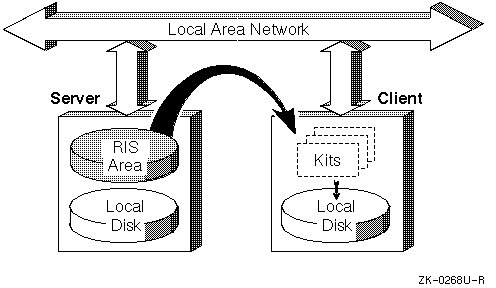
With RIS, the server has a disk area set aside as the RIS area. The RIS area contains copies of software kits to be made available for installation on to clients. Figure 2-1 shows how the RIS system works.
In the RIS area, the server maintains information about what software kits the clients can access. Kits are organized so that a software product can supply several different versions to allow for the differences between multiple hardware platforms (such as Digital UNIX on Alpha systems, ULTRIX MIPS, etc.). The server's RIS area is made available for read-only access to clients by means of the Network File System (NFS) .
The server is a passive partner in the day-to-day operation of a RIS system. Beyond verifying clients' identities and their kit load requests, and managing accepted requests, the server does not interact directly with the clients. A system does not have to be a dedicated RIS server; it can also support local timesharing users.
A RIS client installs software kits on to the server by using the
ris
utility; the utility copies the kit contents across the
network from the server instead of from local media.
Some of the features and benefits of DMS and RIS follow:
utilupdate
utility, servers
running an earlier version of the system can support the current
version.
When RIS starts up, it checks the status of the RIS areas. If RIS can access all the products it was able to access the last time RIS was started, it displays the following message:
Checking accessibility of RIS areas... done
If RIS cannot access all the products, it was able to access previously, it displays the following message:
No Products Available in /var/adm/ris/ris0.alpha


Delete RIS environment? [y]:
This may have occurred because the source for this RIS environment is no longer mounted. This can be corrected by remounting the source. If the source is no longer available, you may choose to delete this RIS environment. If you remount the source, you must restart RIS so that the environment is available.
When you invoke RIS and you are not superuser, the following message may be displayed:
Checking accessibility of RIS areas...
No permission to write /usr/var/adm/ris/ris0.alpha/ProdNames
done
You can correct this problem by invoking RIS again as superuser.
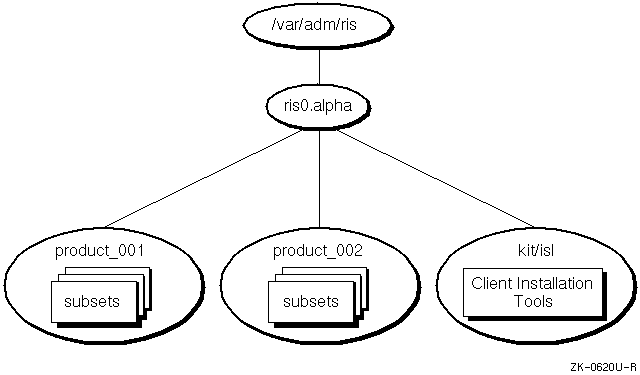
In addition to the server's normal disk area, a partition or area is reserved on the server to hold RIS software kits. This RIS area contains one or more product environments. Each product environment contains one or more software kits suitable for installation on a given hardware/software platform. See Figure 2-2 for a generalized illustration of the RIS area.
In
Figure 2-2,
the RIS area,
/var/adm/ris,
contains one product environment,
ris0.alpha.
Each product environment contains products for a specific
platform. In
Figure 2-2,
the target platform is Alpha processors. Multiple product environments
can exist in a single RIS area. Each product environment contains
one or more product directories, each product directory contains
several product kit archives, called software
subsets.
Figure 2-2
shows a product environment named
ris0.alpha
containing directories called
product_001,
product_002,
product_003,
and so on.
Figure 2-2
also shows the
kit/isl
directory.
The
kit/isl
directory contains installation tools required by clients when they install software
over the network. If your environment is in Direct CD-ROM(DCD) format
the
kit/isl
directory does not exist. An environment in DCD format is the same as
a system disk format it includes
/,/usr,...
The server itself usually does not use any of the RIS area. System administrators can access the product area as required for maintenance and for installation or removal of product kits.
For more flexibility, you can establish multiple RIS areas in separate partitions. RIS areas on a given server can be exported to other servers using the Network File System (NFS). Servers that import such RIS areas can use them as if they were local, supplying the imported subsets to their own set of clients. Section 4.4 describes how to use NFS to mount a RIS area. The Network Administration guide describes how to export and import file systems.
A RIS installation uses the LAN as its installation media instead of the Digital UNIX distribution CD-ROM. A RIS client can install any software kit for which it is registered on the server. The installation procedure runs entirely on the client and, after the necessary software is installed, no continuing relationship is required between the RIS server and client.
The
Digital UNIX
operating system itself can be
among the kits that are available from the server.
To install the operating system,
the client processor is booted across the network using a generic
minimal kernel and file system, both of which are part of the software
kit. The special kernel and file system become resident in the
client's memory. Once booted, the client runs the
installation utility, called
setld,
that is used to install kits on an
already-running, configured platform.
For more information about the
setld
utility, see the
setld(8)
reference page. After the installation is complete, the system is
rebooted using the newly installed software. For additional information
on installation procedures, see the
Installation Guide.
A client must be registered with only one server for the base operating system. If you register a client with more than one server for the base operating system, each server with which the client is registered tries to respond to the client's network boot request (with unpredictable results).
To change the server with which a client is registered for the base operating system, first remove the client from the current server's client database and then register it with the new server. See Chapter 6 for information about registering and removing RIS clients.
A client can be registered with multiple servers
for optional subsets and products other than the base operating system.
When you load optional subsets or layered products with the
setld
command, you specify the name of the server from whom to copy the
kits.