The Network Information Service (NIS, formerly Yellow Pages) is a distributed data lookup service for sharing information on a local area network (LAN). NIS allows you to coordinate the distribution of database information throughout your networked environment.
This chapter describes describes the NIS environment, how to plan for NIS, how to configure your system for NIS, and how to manage NIS servers and clients.
For introductory information on NIS, see
nis_intro(7).
In a NIS environment, systems can have the following roles:
/var/yp/DOMAIN directory and propagates them at regular intervals to the slave servers. Only
the master maps can be modified. Each domain can have only one master server.
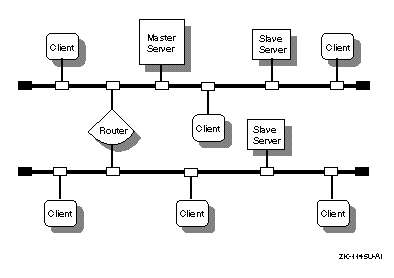
Figure 7-1 shows a domain in which there is a master server, two slave servers, and some clients.
By default, NIS distributes the
aliases,
group,
hosts,
mail.aliases,
netgroup,
networks,
passwd,
protocols,
rpc,
and
services
databases. (The
mail.aliases
and
netgroup
database are created exclusively for NIS.)
You can also create and distribute site-specific customized databases, such as
NFS
automount
maps. For information on creating
automount
maps for distribution by NIS, see
Appendix C.
For information on creating and distributing other site-specific NIS maps,
see the
Section 7.4.5.
In a C2 secure environment, you can run NIS in a secure mode; thereby creating secure and nonsecure versions of the NIS maps. See Security for more information.
This section describes those tasks you need to do before configuring NIS.
For NIS servers, verify that the Additional Networking Servives subset is installed by entering the following command:
#
setld -i | grep OSFINET
If it is not installed, install it by using the
setld
command.
For more information on installing subsets, see
setld(8),
the
Installation Guide,
or the
System Administration
manual.
Appendix A contains a worksheet that you can use to record the information that you need to configure NIS. If you are viewing this manual online, you can use the print feature to print a copy of this part of the worksheet.
Figure 7-2 shows Part 6 of the Configuration Worksheet. The following sections explain the information you need to record in Part 6 of the worksheet.
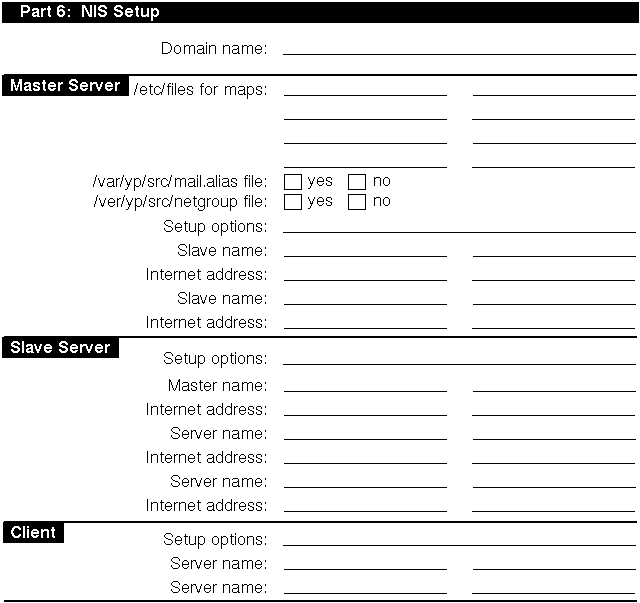
An NIS domain is an administrative entity that consists of a master server, one or more slave servers, and numerous clients. All systems in a domain share the same set of NIS database files.
Note
A NIS domain name is not the same as a BIND domain name. If you configure the system with an incorrect NIS domain name, all NIS-related operations (such as logging in and
ls -lcommands) hang for several minutes, then fail.
Note
The master server and all slave servers are also considered to be NIS clients.
/etc/aliases
/etc/group
/etc/hosts
/etc/networks
/etc/passwd
/etc/protocols
/etc/rpc
/etc/services
mail.aliases
file defines network-wide mail aliases.
If you want to define and distribute mail aliases on your network, check
YES; otherwise, check NO.
If you choose not to create a
mail.aliases
file, the
nissetup
command issues an informational message that it could not find the
mail.aliases
file while it is
building the NIS maps. For information on defining mail aliases, see
aliases(4).
netgroup
file defines network-wide groups and is used for
permission checking when doing remote mounts, remote logins, and remote shells.
If you want to define and distribute
netgroup
information on your network, check YES; otherwise, check NO.
If you choose not to create a
netgroup
file, while it is building the NIS maps, the
nissetup
command issues an informational message that it could not find the
netgroup
file. For information on defining network groups, see
netgroup(4).
yppasswdd
daemon (master server only).
The
yppasswdd
daemon runs on the master server and allows the
master copy of the password file to be updated remotely using the
yppasswd
command. Digital recommends that you run the
yppasswdd
daemon.
C2 security, C2 class of trust as defined in the
Trusted Computer System Evaluation Criteria (TCSEC),
enables you to create secure and nonsecure versions of the NIS maps.
Digital UNIX
provides secure and nonsecure versions of the
passwd
file. For more information, see the
Security
manual and
makedbm(8).
ypbind
daemon to a particular domain name and server list.
Normally, hosts broadcast NIS requests on the network and
the first available server answers the request.
The
-S
option allows you to lock the
ypbind
daemon to a particular domain and set of servers. Requests
are made directly to the specified servers, rather than
being broadcast. Digital recommends that you run NIS with the
-S
option configured.
If you choose to run NIS with the
-S
option configured, you must know the host names and IP addresses of the servers
to which you are locking the
ypbind
daemon.
Security Note
When using the
nissetupscript to set up an NIS server that is running with enhanced security, you must answer YES to the question about locking the domain name and authorized servers (theypbind -Soption). For a master server, the server is bound to itself by default.
-ypset
option, the
-ypsetme
option, or with both options set.
The
-ypset
option allows a user logged in as
root
on any system in your domain to bind your system to a particular server. The
-ypsetme
option allows
ypbind
to accept
-ypset
requests only from the local system.
Digital recommends that you run NIS with neither the
-ypset
nor the
-ypsetme
options.
C2 security, C2 class of trust as defined in the
Trusted Computer System Evaluation Criteria (TCSEC),
enables you to create secure and nonsecure versions of the NIS maps.
Digital UNIX
provides secure and nonsecure versions of the
passwd
file. For more information, see the
Security
manual and
makedbm(8).
ypbind
daemon to a particular domain name and server list.
Normally, hosts broadcast NIS requests on the network and
the first available server answers the request.
The
-S
option allows you to lock the
ypbind
daemon to a particular domain and set of servers. Requests
are made directly to the specified servers, rather than
being broadcast. Digital recommends that you run NIS with the
-S
option configured.
If you choose to run NIS with the
-S
option configured, you must know the host names and IP addresses of the servers
to which you are locking the
ypbind
daemon.
Security Note
When using the
nissetupscript to set up an NIS server that is running with enhanced security, you must answer YES to the question about locking the domain name and authorized servers (theypbind -Soption). For a slave server, the server is bound to itself by default and optionally to the master server and any other slave servers.
-ypset
option, the
-ypsetme
option, or with both options set.
The
-ypset
option allows a user running as
root
on any system in your domain to bind your system to a particular server. The
-ypsetme
option allows
ypbind
to accept
-ypset
requests only from the local system.
Digital recommends that you run NIS with neither the
-ypset
nor the
-ypsetme
options.
C2 security, C2 class of trust as defined in the
Trusted Computer System Evaluation Criteria (TCSEC),
enables you to create secure and nonsecure versions of the NIS maps.
Digital UNIX
provides secure and nonsecure versions of the
passwd
file. For more information, see the
Security
manual and
makedbm(8).
ypbind
daemon to a particular domain name and server list.
Normally, hosts broadcast NIS requests on the network and
the first available server answers the request.
The
-S
option allows you to lock the
ypbind
daemon to a particular domain and set of servers. Requests
are made directly to the specified servers, rather than
being broadcast. Digital recommends that you run NIS with the
-S
option configured.
If you choose to run NIS with the
-S
option configured, you must know the host names and IP addresses of the servers
to which you are locking the
ypbind
daemon.
-ypset
option, the
-ypsetme
option, or with both options set.
The
-ypset
option allows a user logged in as
root
on any system in your domain to bind your system to a particular server. The
-ypsetme
option allows
ypbind
to accept
-ypset
requests only from the local system.
Digital recommends that you run NIS with neither the
-ypset
nor the
-ypsetme
options.
automount
program.
The
automount
program, an alternative to mounting remote file
systems, allows users to mount remote file systems on an as-needed basis.
When NIS is used to distribute
automount
maps, creating and administering the maps for the NIS domain is the
responsibility of the administrator of the NIS master server. For information
on creating
automount
maps, see
Appendix C.
For information on administering
automount
maps, see
Section 8.1.2.
Whether you use the
automount
program depends on your site's networking environment.
To configure NIS, use the the
nissetup
script. You can configure a master server, slave server, or client. See
nissetup(8)
for more information.
To invoke
nissetup,
do the following:
Note
For systems without graphics capabilities, you can invoke
nissetupfrom the command line.
You must configure the master NIS server before you can configure the other
systems. Prior to using the
nissetup
script, you must log in as
superuser and complete the following presetup tasks:
/var/yp/src
directory the local
/etc
files that you intend to make into NIS maps for distribution.
If a file is absent from the
/var/yp/src
directory while it is building the default NIS maps, the
nissetup
command issues an informational message that it could
not find that particular file and continues building the maps.
Note
If you copied the
passwdfile into the/var/yp/srcdirectory, remove therootentry from the file.
/var/yp/src/mail.aliases
file.
/var/yp/src/netgroup
file.
/var/yp/Makefile
file.
If you are using the NIS master server to serve the
/etc/auto.master
and
/etc/auto.home
automount maps, you must remove the comment sign (#) from the
beginning of each of the following lines. These lines were added to
the
Makefile
for the
automount
daemon.
.
.
.

#all: passwd group hosts networks rpc services protocols netgroup \
#     aliases auto.home auto.master

.
.
.

#$(YPDBDIR)/$(DOM)/auto.home.time: $(DIR)/auto.home
#        -@if [ -f $(DIR)/auto.home ]; then \
#              $(SED) -e "/^#/d" -e s/#.*$$// $(DIR)/auto.home | \
#              $(MAKEDBM) - $(YPDBDIR)/$(DOM)/auto.home; \
#              $(TOUCH) $(YPDBDIR)/$(DOM)/auto.home.time; \
#              $(ECHO) "updated auto.home"; \
#              if [ ! $(NOPUSH) ]; then \
#                      $(YPPUSH) auto.home; \
#                      $(ECHO) "pushed auto.home"; \
#              else \
#                      : ; \
#              fi \
#       else \
#               $(ECHO) "couldn't find $(DIR)/auto.home"; \
#       fi
#
#$(YPDBDIR)/$(DOM)/auto.master.time: $(DIR)/auto.master
#        -@if [ -f $(DIR)/auto.master ]; then \
#             $(SED) -e "/^#/d" -e s/#.*$$// $(DIR)/auto.master | \
#             $(MAKEDBM) - $(YPDBDIR)/$(DOM)/auto.master; \
#             $(TOUCH) $(YPDBDIR)/$(DOM)/auto.master.time; \
#             $(ECHO) "updated auto.master"; \
#             if [ ! $(NOPUSH) ]; then \
#                    $(YPPUSH) auto.master; \
#                    $(ECHO) "pushed auto.master"; \
#             else \
#                     : ; \
#             fi \
#       else \
#               $(ECHO) "couldn't find $(DIR)/auto.master"; \
#       fi

.
.
.

#auto.home: $(YPDBDIR)/$(DOM)/auto.home.time
#auto.master: $(YPDBDIR)/$(DOM)/auto.master.time

.
.
.

#$(DIR)/auto.home:
#$(DIR)/auto.master:
Place a comment sign (#) in front of the following lines:
all: passwd group hosts networks rpc services protocols netgroup \
aliases
If you are using the NIS master server to serve other site-specific
maps, you must add an entry for them to the
Makefile.
See the
Section 7.4.7.1
for information on adding entries for
site-specific NIS maps, other than the
/etc/auto.master
and
/etc/auto.home
automount
maps, to the
/var/yp/Makefile
file.
automount
maps, or any other site-specific maps, to the
/var/yp/src
directory.
For information on creating
automount
maps, see
Appendix C.
For information on creating other site-specific maps, see the
Section 7.4.7.1.
To continue to set up the master server, log in as root and run the
nissetup
script:
nissetup
script either from the CDE Desktop
or by entering the following command:
#
/usr/sbin/nissetup
A message appears reminding you that your network must be established before setting up NIS, and that in order to set up an NIS server you must have the Additional Networking Services subset installed.
c
to continue.
nissetup,
and then press Return again after the script explains the three types
of systems in an NIS domain.
nissetup
script's explanation that there can
be only one master server configured for each NIS domain, enter
c
and indicate whether you want to run the
yppasswdd
daemon.
Digital recommends that you run the
yppasswdd
daemon on the master NIS server.
If you enter the name of a host that is not listed in the
master server's
/etc/hosts
file, the
nissetup
script prompts you for its IP address.
Enter the names of the SLAVE servers in the test_domain domain.
Press Return to terminate the list.
   Host name of slave server:
host2


   Host name of slave server:
host3
      Cannot find host3 in the file /etc/hosts.
      To add host3 to the /etc/hosts file you MUST
                know host3's Internet (IP) address.
  Would you like to add host3 to the /etc/hosts file
        (y/n) [y]?
y


  What is host3's Internet (IP) address [no default] ?
120.105.1.28


  Is 120.105.1.28 correct (y/n) [no default] ?
y


   Hostname of slave server:
[Return]
The
nissetup
script displays the list of servers that you
entered and gives you the option to redo it to correct errors or to continue
with the setup procedure.
The
nissetup
script then creates the default NIS maps,
displaying messages similar to the following as it does:
Creating default NIS maps.  Please wait...
updated passwd
updated group
updated hosts
updated networks
updated rpc
updated services
updated protocols
updated netgroup
Finished creating default NIS maps.
-s
security option.
If you choose to the
-s
option, the
ypbind
process runs in a secure mode.
-S
security option.
If you choose to run the
-S
option, you must enter the names of up to four NIS servers.
The
nissetup
script automatically places the host name of the
server you are configuring first. Press Return when you are
done entering server names.
Digital recommends that you use the
-S
option.
ypset
requests on your system.
Digital recommends that you disallow all
ypset
requests. Press Return to accept the default, and confirm your choice.
Digital recommends that you use all of the NIS databases.
If you choose to use all of the NIS databases (either enter
y
or accept the default), the
nissetup
script edits the
/etc/svc.conf
file to include the string
yp
for each database. It also edits the
/etc/passwd
and
/etc/group
files to include
a plus sign followed by a colon
(+:)
at the end of each file.
This enables your system to use NIS for each
database listed. This symbol enables the files to be distributed by NIS.
Continue with step 18.
If you choose not to use all of the NIS databases enter
n,
continue with the next step.
+:)
to the end of the local
/etc/passwd
and
/etc/group
files.
For your system to use the NIS served
passwd
database,
group
database, or both,
+:
must be the last line in the file or files you
want served by NIS. This applies to the
passwd
and
group
databases only.
Note
The service order selection for the
passwdandgroupdatabases is handled by the Security Integration Architecture (SIA). IfBSDis selected forpasswdandgroupinformation in the/etc/sia/matrix.conffile, only the+:is required for your system to search NIS.
/etc/passwd
and
/etc/group
which were defined in step 11).
If you answer yes,
nissetup
edits the
svc.conf
file to include the string
yp
for each database. The
nissetup
script then skips the next question and continues at step 14.
If you answer no,
nissetup
continues with the next question.
nissetup
script to invoke the
svcsetup
script. (Note, if you answered yes to step 16, skip this step.)
If you answer yes,
nissetup
invokes the
svcsetup
script, which allows you to modify the database services selection file (the
svc.conf
file). See
Section 7.3.4
for information on modifying the
svc.conf
file.
If you answer no,
nissetup
continues with the next question. Note that you must edit the
svc.conf
file if you want your system to use NIS to obtain database information other
than
passwd
and
group
information. See
svcsetup(8)
for information on editing the
svc.conf
file with
svcsetup
or manually.
If you answer yes,
nissetup
starts the daemons.
If you answer no, use the following command to start the
daemons manually after
nissetup
exits and returns you to the system prompt (#):
#
/sbin/init.d/nis start
To configure a slave server, do the following:
nissetup
from the CDE Desktop or by entering the following command:
#
/usr/sbin/nissetup
A message appears reminding you that your network must be established before setting up NIS, and that in order to set up an NIS server you must have the Additional Networking Services subset installed.
c
to continue.
nissetup,
and then press Return again after the script explains the three types
of systems in an NIS domain.
c
to continue following the
nissetup
script's explanation that the master server's list must
include each slave server, and that the master server must
be established in order for maps to be copied to the slave server.
-s
security option.
If you choose to the
-s
option, the
ypbind
process runs in a secure mode.
-S
security option.
If you choose to run the
-S
option, you must enter the names of up to four NIS servers.
The
nissetup
script automatically places the host name of the
server you are configuring first. Press Return when you are
finished entering server names.
Digital recommends that you use the
-S
option.
If you enter the name of a host that is not listed in the
slave server's
/etc/hosts
file, the
nissetup
script prompts you for its IP address.
When you finish entering the list of servers, enter
c
to continue configuring NIS on your system.
ypset
requests on your system.
Digital recommends that you disallow all
ypset
requests. Press Return to accept the default and confirm your choice.
Digital recommends that you use all of the NIS databases.
If you choose to use all of the NIS databases (either enter
y
or accept the default), the
nissetup
script edits the
/etc/svc.conf
file to include the string
yp
for each database. It also edits the
/etc/passwd
and
/etc/group
files to include
a plus sign followed by a colon
(+:)
at the end of each file.
This enables your system to use NIS for each database listed. This symbol
enables the file to be distributed by NIS. Continue with step 15.
If you choose not to use all of the NIS databases, enter
n,
continue with the next step.
+:
to the end of the local
/etc/passwd
and
/etc/group
files.
For your system to use the NIS-served
passwd
database,
group
database, or both,
+:
must be the last line in the file or files you
want NIS to serve. This applies to the
passwd
and
group
databases only.
Note
The service order selection for the
passwdandgroupdatabases is handled by the Security Integration Architecture (SIA). IfBSDis selected forpasswdandgroupinformation in the/etc/sia/matrix.conffile, the+:only is required for your system to search NIS.
If you answer yes,
nissetup
edits the
svc.conf
file to include the string
yp
for each database. The
nissetup
script then skips the next question and continues at step 15.
nissetup
script to invoke the
svcsetup
script. (Note, if you answered yes to step 13, skip this step.)
If you answer yes,
nissetup
invokes the
svcsetup
script, which allows you to modify the database
services selection file (the
svc.conf
file). See
Section 7.3.4
for information on modifying the
svc.conf
file.
If you answer no,
nissetup
continues with the next question.
Note that you must edit the
svc.conf
file if you want your
system to use NIS to obtain database information other than
passwd
and
group
information. See
svcsetup(8)
for information on editing the
svc.conf
file with
svcsetup
or manually.
If you answer yes,
nissetup
starts the daemons.
If you answer no, use the following command to start the
daemons manually after
nissetup
exits and returns you to the system prompt (#):
#
/sbin/init.d/nis start
To configure an NIS client, do the following:
nissetup
script from the CDE Desktop or
by entering the following command:
#
/usr/sbin/nissetup
A message appears reminding you that your network must be established before setting up NIS, and that in order to set up an NIS server you must have the Additional Networking Services subset installed.
c
to continue.
nissetup,
and then press Return again after the script explains the three types
of systems in an NIS domain.
c
to continue following the
nissetup
script's warning that at least one server must be
configured for this domain.
-s
security option.
If you choose to the
-s
option, the
ypbind
process runs in a secure mode.
-S
security option.
If you choose to run the
-S
option, you must enter the names of up to four NIS servers.
If you enter the name of a host that is not listed in the client's
/etc/hosts
file, the
nissetup
script prompts you for its IP address. After you finish entering the list of
servers, enter
c
to continue configuring NIS on your system.
ypset
requests on your system.
Digital recommends that you disallow all
ypset
requests. Press Return to accept the default, and confirm your choice.
Digital recommends that you use all of the NIS databases.
If you choose to use all of the NIS databases (either enter
y
or accept the default), the
nissetup
script edits the
/etc/svc.conf
file to include the string
yp
for each database. It also edits the
/etc/passwd
and
/etc/group
files to include a plus sign followed by a colon
(+:)
at the end of each file. This enables your system to use NIS
for each database listed. This symbol enables the file to be distributed by
NIS. Continue with step 14.
If you choose not to use all of the NIS databases, enter
n
and continue with the next step.
+:
to the end of the local
/etc/passwd
and
/etc/group
files.
For your system to use the NIS served
passwd
database,
group
database, or both,
+:
must be the last line in the file or files you want served by NIS. This applies
to the
passwd
and
group
databases only.
Note
The service order selection for the
passwdandgroupdatabases is handled by the Security Integration Architecture (SIA). IfBSDis selected forpasswdandgroupinformation in the/etc/sia/matrix.conffile, only the+:is required for your system to search NIS.
If you answer yes,
nissetup
edits the
svc.conf
file to include the string
yp
for each database. The
nissetup
script then skips the next question and continues at step 14.
If you answer no,
nissetup
continues with the next question.
nissetup
script to invoke the
svcsetup
script. (Note, if you answered yes to step 10, skip this step.)
If you answer yes,
nissetup
invokes the
svcsetup
script, which allows you to modify the database services selection file (the
svc.conf
file). See
Section 7.3.4
for information on modifying the
svc.conf
file.
If you answer no,
nissetup
continues with the next question. Note that you must edit the
svc.conf
file if you want your system to use NIS to distribute database information
other than
passwd
and
group
information. See
svcsetup(8)
for information on editing the
svc.conf
file with
svcsetup
or manually.
If you answer yes,
nissetup
starts the daemons.
If you answer no, use the following command to start the daemon manually after
nissetup
exits and returns you to the system prompt (#):
#
/sbin/init.d/nis start
If you choose not to use NIS for all of the default databases, the
nissetup
script provides the option of editing the
/etc/svc.conf
file with the
svcsetup
script. If you answer yes when
nissetup
asks if you want to run
svcsetup,
it invokes the
svcsetup
script. Use the following procedure to edit the
/etc/svc.conf
file:
m
option from the Configuration Menu.
If you choose the default (2), the local
/etc
files will be
searched first for the requested information. If the information is not found
locally, then an NIS server will be queried. This choice is valid for all
of the databases that NIS serves.
To have NIS serve
hosts
information if your system is also having
hosts
information served by BIND, choose either option 5
local,bind,yp
or 6
bind,local,yp
for the
hosts
database. Note that options 3
local,bind,
4
bind,local,
5, and 6 are valid for the
hosts
database only.
If you configure NIS and run the
nissetup
script, you can modify or remove the NIS configuration.
If you choose to modify the NIS configuration, the
nissetup
script proceeds as described in
Section 7.3.1
to
Section 7.3.3,
resulting in a new configuration.
If you choose to remove the NIS configuration, the
nissetup
script prompts you to verify your choice, then removes the NIS information from
the following files:
/etc/rc.config
/etc/passwd
/etc/group
/etc/svc.conf
/var/yp/DOMAIN (where
DOMAIN
is the name of the current NIS domain)
This directory and its contents are deleted (for NIS master and slave servers only).
This section describes how to perform the following NIS server tasks:
Adding a slave server to a domain enables the slave server to receive updated NIS maps from the master server and serve them to NIS clients in a domain.
To add an NIS slave server to a domain, do the following:
/var/yp
directory by using the
cd
command.
ypservers
map and direct the output to a file by
using the following command:
#
makedbm -u domainname/ypservers > filename
ypservers
map by using the
makedbm
command as follows:
#
makedbm filename ypservers
You can combine steps 4, 5, and 6 into one command line. See the example at the end of these steps.
ypservers.dir
and
ypservers.pag
map files to the domain subdirectory.
ypservers
map to the slave servers by using the
yppush
command.
hosts
file and add an
entry for the slave server, if it is not already in the
hosts
file. Then update the map by entering the
make
command. The
make
command also distributes the updated map.
See
makedbm(8)
for more information on building maps.
The following example (illustrating steps 3 through 9) shows how to add slave
server
host8
to domain
market:
#
cd /var/yp


#
/var/yp/makedbm -u market/ypservers ; echo host8\ [1]


 |/var/yp/makedbm - tmpmap


#
mv tmpmap.dir market/ypservers.dir [2]


#
mv tmpmap.pag market/ypservers.pag


#
yppush ypservers [3]


#
vi /var/yp/src/hosts  [4]

.
.
.


#
make hosts  [5]
makedbm
command with the
-u
option is displayed and the new server name,
host8,
is echoed on standard output to add it to the file. Then, the output is piped
back into the
makedbm
command to build a new map named
tmpmap.
Note
You can type the first and second lines as one command even if the line wraps on your screen, or you can use the backslash escape character (\), as shown.
tmpmap.dir
and
tmpmap.pag
map files to the domain
market
subdirectory and renames them as
ypservers
map files.
[Return to example]
hosts
NIS map on the master server.
[Return to example]
Section D.1
contains a sample script you can copy that
performs the steps involved in adding a slave server to a domain. You will
still have to set up the slave server and edit the master server's
hosts
file, adding a slave server entry, if necessary. The
script does not do those steps.
Removing a slave server from a domain means that the system will no longer receive updated NIS maps from the master server and serve them to NIS clients in a domain.
To remove an NIS slave server from the domain, do the following:
If the system is going to be an NIS client, configure it as an NIS client by
using
nissetup.
See
Section 7.3.3
for more information.
If the system will no longer use NIS, turn off the NIS configuration flag
in the
/etc/rc.config
file by using the following command:
#
/usr/sbin/rcmgr set NIS_CONF NO
/var/yp
directory by using the
cd
command.
ypservers
map and direct the output to a file by
using the following command:
#
makedbm -u ypservers > filename
makedbm
command as follows:
#
makedbm filename ypservers
You can combine steps 4, 5, and 6 into one command line. See the following examples.
ypservers.dir
and
ypservers.pag
map files to the domain subdirectory.
ypservers
map to the slave servers by using the
yppush
command.
See
makedbm(8)
for more information on building maps.
The following example (illustrating steps 4 through 8) shows how to remove
slave server
host4
from domain
market:
#
/var/yp/makedbm -u market/ypservers |\ [1]


 grep -v host4 | /var/yp/makedbm - tmpmap


#
mv tmpmap.dir market/ypservers.dir  [2]


#
mv tmpmap.pag market/ypservers.pag


#
yppush ypservers [3]
makedbm
command with the
-u
option is piped into
grep
with the
-v
option to display all lines except the one containing the slave server name
(host4).
Then, the output is piped back into the
makedbm
command to build a new map named
tmpmap.
Note
You can type the first and second lines as one command even if the line wraps on your screen, or you can use the backslash escape character (\), as shown.
tmpmap.pag
and
tmpmap.dir
map files to the domain
market
subdirectory and renames them as
ypservers
map files.
[Return to example]
Section D.2 contains a sample script you can copy that performs the steps involved in removing a slave server from a domain. You will still have to reconfigure the slave server as an NIS client or as a system that does not use NIS. The script does not do that for you.
Adding a new user to an NIS domain includes the user in the
passwd
map and allows the user to participate in the NIS
environment. A user has only one password on all systems that use NIS for
their
passwd
map.
To add a user to an NIS domain, do the following:
/var/yp/src/passwd,
and add an entry for the new user.
The master
passwd
file is a readable ASCII file with a one-line
entry for each valid user on the system. Here is a sample
passwd
file entry for a user named Jane Doe:
doe:fnuTqqab.6yec:444:10:Jane Doe:/usr/staff/doe:/bin/csh
See
System Administration
for a description of how to edit the
passwd
file to add a new user.
Note
The remote systems on the network recognize a user by the user identification (UID) number. Therefore, it is important that each user have the same UID number on each of the systems on the network.
/var/yp
directory by using the
cd
command.
passwd
map by using the
make
command.
passwd
file.
You can define login environments for new users in several ways. For example,
you can give new users a copy of the
.login
and
.cshrc
files if they use the C shell
(/bin/csh),
or the
.profile
file if they use the Bourne shell
(/bin/sh).
Copies of the default environment files are stored in the
/usr/skel
directory. See
System Administration
and
csh(1)
and
sh(1)
for further information about setting up a new user's environment.
If the new user is a member of any groups at your site, add the user's login
name to the master
group
and
netgroup
files on the NIS master server as necessary. See
group(4),
netgroup(4),
and
groups(1)
for more information about user groups.
chown
command.
yppasswd
command.
The following example (illustrating steps 2 through 4) shows how to add a new user to a domain:
#
vi /var/yp/src/passwd  [1]

.
.
.


#
cd /var/yp  [2]


#
make passwd  [3]
/var/yp/src/passwd
file for editing.
[Return to example]
/var/yp
directory.
[Return to example]
passwd
map and distributes
the updated map to the slave servers.
[Return to example]
You would then set up the new user's environment and have the user set the NIS password to complete the task.
Updating an NIS map involves making changes to an NIS map's master file,
updating the
Makefile
file (if the map is not listed), and
building and distributing the new map. Entries for the following standard maps
are included in the
Makefile
file:
passwd
group
hosts
networks
rpc
services
protocols
netgroup
aliases
The master files are located in
/var/yp/src
on the NIS master server.
To update an NIS map, do the following:
/var/yp
directory by using the
cd
command.
Makefile
file, if no entry exists in the
/var/yp/Makefile
file for the map you want to update.
See
Section 7.4.7
for information on modifying the
Makefile
file.
/var/yp/src
directory by using the
cd
command.
/var/yp
directory by using the
cd
command.
make
command as
follows:
#
make map_name
The following example (illustrating steps 4 through 7) shows how to update the
hosts
map:
#
cd var/yp/src  [1]


#
vi hosts   [2]

.
.
.

#
cd /var/yp  [3]


#
make hosts  [4]
/var/yp/src
directory.
[Return to example]
/var/yp/src/hosts
file for editing.
[Return to example]
/var/yp
directory.
[Return to example]
Adding an NIS map to a domain allows the database information to be distributed throughout an NIS domain. You can create and distribute maps for any information you want to distribute.
To add an NIS map to a domain, do the following:
A master file is an ASCII text file containing individual entries. Each entry
has fields separated by spaces. Some of these fields are used to build a key
to each entry. Review some of the master files in the
/var/yp/src
directory to
better understand the structure of a master file.
auto.master
in the
/var/yp/src
directory. If the file exists, add an entry for the NFS automount map you want
to distribute.
See
Section 8.1.2
and
Appendix C
for more
information on the
auto.master
map.
/var/yp/Makefile
file to include the new map in the default set of maps.
See
Section 7.4.7
for information on modifying the
Makefile
file.
/var/yp
directory by using the
cd
command.
make
command as follows:
#
make map_name
The following example adds the
phonelist
map to a domain:
#
vi /var/yp/src/phonelist  [1]

.
.
.

#
vi /var/yp/Makefile  [2]

.
.
.

#
cd /var/yp  [3]


#
make phonelist  [4]
phonelist
master file on the master server.
[Return to example]
Makefile
file and adds
phonelist
entries.
[Return to example]
Removing an NIS map from a domain prevents the database information from being distributed throughout an NIS domain.
To remove an NIS map from a domain, do the following:
auto.master
file in the
/var/yp/src
directory.
See
Section 8.1.2
and
Appendix C
for more information on the
auto.master
map.
/var/yp/Makefile
file to remove the map from the default set of maps.
See
Section 7.4.7
for information on modifying the
Makefile
file.
Modifying the
Makefile
file means adding or deleting database
entries in the
/var/yp/Makefile
file on the NIS master server.
By adding a database entry to the
Makefile
file, you indicate
that you want a map produced for the specific database when you use the
make
command. By deleting a database entry, you indicate that
you do not want a map produced for the specific database.
To add an entry to the
Makefile
file, do the following:
/var/yp/Makefile
file and add the database name to
the line beginning with
all:.
Next, add a line with the following format to the end of the file:
database_name: database_name.time
Finally, add an entry with the following format to the middle of the file:
database_name.time: various_commands
To simplify the creation of this entry, copy the
auto.home.time:
entry in the file and make the necessary database name changes.
auto.master
string by deleting the comment character (#) that precedes it.
The following example shows the
phonelist
database added to the
/var/yp/Makefile
file. There is a tab character preceding the
netgroup
database name in the
all:
line.
all: passwd group hosts networks rpc services protocols \
        netgroup aliases phonelist

.
.
.

$(YPDBDIR)/$(DOM)/phonelist.time: $(DIR)/phonelist
 	     -@if [-f $(DIR)/phonelist ]; then \
	           $(SED) -e "/^#/d" -e s/#.*$$// $(DIR)/phonelist | \
	           $(MAKEDBM) - $(YPDBDIR)/$(DOM)/phonelist; \
	           $(TOUCH) $(YPDBDIR)/$(DOM)/phonelist.time; \
	           $(ECHO) "updated phonelist"; \
	           if [ ! $(NOPUSH) ]; then \
	                   $(YPPUSH) phonelist; \
	                   $(ECHO) "pushed phonelist"; \
	           else \
	                   : ; \
	           fi \
	else \
	           $(ECHO) "couldn't find $(DIR)/phonelist"; \
	fi

.
.
.

phonelist: phonelist.time
To delete an entry from the
Makefile
file, do the following:
/var/yp/Makefile
file, delete the database name
from the line beginning with
all:,
and delete the line beginning
with the database name
(database_name:).
Instead of deleting the database line, you could comment out the line by adding a number sign (#) to the beginning of the line.
As you edit the
/var/yp/Makefile
file, remember the following:
all:
is not important. However, in continuation lines, the blank space preceding the
line must be a tab character; do not use spaces.
Makefile
file.
By default, the
ypserv
and
ypxfrd
daemons provide
NIS information to anyone with network access to an NIS server that makes a
reqest. However, you can restrict NIS database access to only those hosts in
subnets you specify by completing the following steps:
/var/yp/securenets
file.
/var/yp/securenets
file and add an entry for
each subnet from which the NIS server is to accept NIS requests. The format of
each file entry is as follows:
subnet_mask subnet_ip_address
For example:
255.255.0.0  128.30.0.0   [1]
255.255.255.0 128.211.10.0    [2]
255.255.255.255 128.211.5.6   [3]
128.30
range to access the
NIS files. The network mask is
255.255.0.0
and the corresponding network
address is
128.30.0.0.
[Return to example]
128.211.10
range to access the NIS files.
[Return to example]
128.211.5.6
to access the NIS files.
[Return to example]
If the file does not exist or contains no entries, the server accepts any NIS request.
If the file exists and contains entries, the
ypserv
and
ypxfrd
daemons read the
/var/yp/securenets
file during initialization. When an NIS request is received, the requester's
IP address is compared to the subnets in the
/var/yp/securenets
file. If it matches, the request is processed. If it does not match,
the NIS request is rejected and the rejection is recorded in the NIS server's
log file. For example:
ypxfrd: An attack by non-trusted host, 128.40.16.122
On the system making the NIS request, NIS commands such as
ypcat
terminate with no error message. If a user is trying to log in to a system,
the login times out after many retries.
Note
If the
/var/yp/securenetsfile is modified, the you must kill and restartypservandypbind.
NIS slave servers can also use a
/var/yp/securenets
file
to restrict IP addresses to which it serves. However, the NIS slave server's
IP address must be in the authorization range of entries in the
/var/yp/securenets
file of the NIS master.
This section describes how to perform the following NIS client management tasks:
To change a user's password that is stored in the NIS
passwd
map, use the
yppasswd
command. If you receive an error message,
ask the system administrator on the master server to verify that the
rpc.yppasswdd
daemon on the NIS master server is running.
If you try to change your password with the
passwd
command, you
might receive the following error message:
Not in passwd file.
This message means your password is stored and distributed in NIS. You must
change your password by using the
yppasswd
command.
To change the root password, use the
passwd
command. This password is local and not in the NIS file.
See
yppasswd(8)
and
rpc.yppasswdd(8)
for further information.
Obtaining NIS map information enables you to see the following information:
To obtain NIS map information, issue one of the commands listed in Table 7-1.
| Command | Action |
ypcat
|
Prints values from an NIS database |
ypwhich
|
Prints the name of the master server for an NIS map |
ypmatch
|
Prints the values of one or more keys from an NIS map |
Use the
-x
option with any of the commands shown in
Table 7-1
to list all the map nicknames.
See
ypcat(1),
ypwhich(1),
and
ypmatch(1)
for more information about these commands.
The following command lists all available maps and their master servers:
#
ypwhich -m
The following command lists all values in the
hosts
map:
#
ypcat hosts
The following command lists all occurrences in the
hosts
map
that have the key
apple:
#
ypmatch apple hosts
The following command lists all occurrences in the
hosts
map
that have the name
jones
associated with them. The name
jones
is not a key in this map.
#
ypcat hosts | grep jones